The 2026 Laundry Dilemma: A Real Talk Guide
Samsung Front Load vs. Top Load: Which one actually fits your life?
Table of Contents
I. My Personal Laundry Story
Let’s be honest for a second: nobody actually loves doing laundry. It’s that endless cycle of, “Did I leave the wet clothes in the drum too long?” And why is this shirt suddenly two sizes smaller? In 2026, washing machines have become incredibly smart; some can even tell you when you’re running low on detergent, but the basic struggle remains.
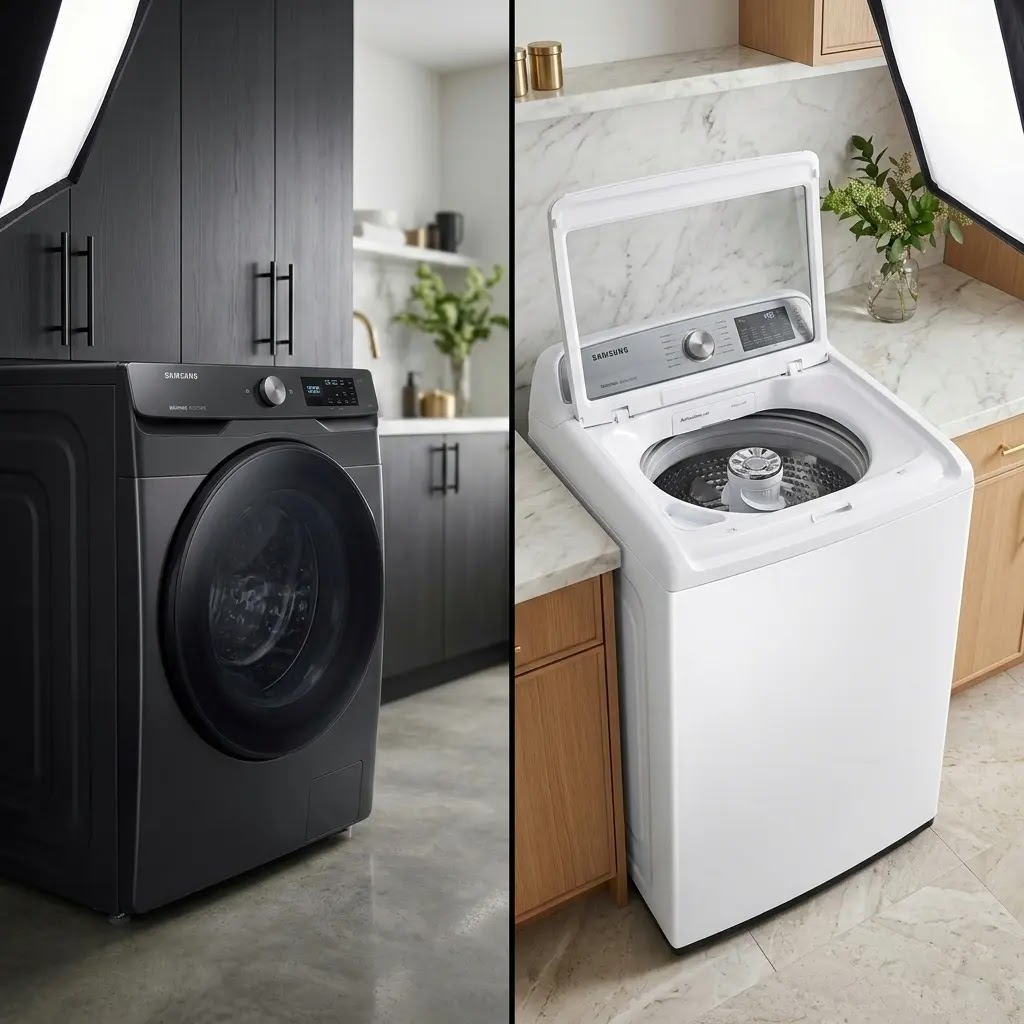
A few years ago, I stood in a bright showroom looking at two Samsung machines. One was a sleek, glass-door front-load that looked like it belonged in a spaceship. The other was a sturdy, familiar top-load that promised to finish a mountain of clothes in no time. I chose based on looks, and honestly? I regretted it for six months because I hadn’t considered how much I hate bending down every morning.
Buying a washing machine in 2026 isn’t just about picking a box that spins. It’s about your back health, your monthly water bills, and making sure your expensive workout gear doesn’t fall apart.
Technical Pro-Tip: Many users get stuck right at the start because of smart sensors. If your new machine seems to be taking forever to start, you might be hitting a common software hiccup; check out our guide on Samsung AI Washer Stuck on Calculating. Fix the load sensor loop to get things moving. Let’s break down the technical reality of Samsung’s latest lineup so you don’t make the same mistakes I did.
II. The Mechanical Heart: How They Spin
To understand which is better, you have to understand how they fight dirt.
Front Load (The Tumble Action): Imagine taking a wet towel and dropping it onto the floor repeatedly. That is essentially what a front-load machine does. It uses gravity to lift the clothes to the top of the drum and drop them into the soapy water. This tumbling is much gentler than scrubbing. Because there is no big pole in the middle, your clothes have more room to move, leading to a much better clean with less wear and tear.
Top Load (Wobble Technology): Samsung has spent years fixing the biggest problem with top loaders: the tangling. Older machines used to twist clothes until they looked like a giant knot. Samsung’s 2026 models use something called Wobble Technology. Instead of just spinning left and right, the pulsator at the bottom moves in multiple directions. It creates a 3D water flow that keeps clothes floating rather than twisting. It’s better than the old days, but it still uses more friction than a front loader.

III. Material Science & Fabric Care
If you own expensive silk, delicate wool, or high-performance gym wear, this section matters most.
The G-Force Factor: Front-loaders spin much faster, often reaching 1400 RPM. This high speed pulls almost all the water out of the fabric. However, if your machine is struggling to reach these speeds or finishes a cycle with soaking-wet clothes, you might be dealing with a Samsung washer that won’t spin. Fix the 7-Minute (2026 DIY Guide) to restore its high-speed performance.
Steam Wash & Hygiene: Samsung’s front-loaders come with a built-in heater that generates actual steam. This isn’t just a marketing gimmick; the steam opens the fibers of your clothes, releasing deep-seated dirt and killing 99.9% of bacteria. While some high-end Samsung top-loaders now have heaters, the front-load design is naturally better at trapping heat and using steam efficiently.
The Mold Problem: Here is the ugly truth about front-loaders. They have a thick rubber seal that traps water, where mold starts to grow. To prevent this, following the Samsung Washing Machine Maintenance Guide is essential for any front-load owner.
The 2026 Microfiber Filter: Environmental regulations have become stricter. Samsung’s latest front loaders now feature the Less Microfiber™ cycle. This specialized wash program reduces microplastic shedding from synthetic fabrics by up to 54%. If you care about ocean health as much as you care about your clothes, this built-in filtration is a massive technical upgrade over older top-load models.
IV. Energy & Resource Efficiency (The Math)
Let’s talk about your wallet. In 2026, energy prices are higher than ever, and water conservation is a global priority.
Water Usage: A Samsung front loader is the undisputed king here. It only fills the bottom of the drum with water. As the drum turns, the clothes get soaked. A top-loading washer, even a high-efficiency one, usually needs to submerge the clothes more. On average, a front loader uses 35% to 40% less water per cycle. Over a year, that’s thousands of liters saved.
Electricity & AI Energy Mode: Samsung’s 2026 SmartThings app now includes an AI Energy Mode. It monitors how much power your machine uses in real time. Because front-loaders use less water, they also require less energy to heat that water. However, top-loaders often have shorter cycle times, which can sometimes offset electricity use if you only wash in cold water.
Technical Pro-Tip: The Power Factor. While front-loaders save water, they are more electronically sensitive. Samsung’s high-torque motors require a stable voltage. In 2026, with the rise of home solar and smart grids, I highly recommend a dedicated surge protector for a front-loading washing machine. Their main PCB (the brain) is 30% more expensive to replace than a top loader’s board if a power spike occurs.
Heat Pump Synergy: While front loaders have always been efficient, Samsung’s 2026 lineup uses heat pump-integrated heating elements. Unlike traditional resistance heaters that gulp electricity, this system recycles warm air to maintain water temperature. When paired with a Samsung heat pump dryer, the system communicates to optimize the total energy budget of your laundry room, often resulting in a Grade-A energy rating that was impossible five years ago.
V. Technical Features Comparison (Samsung Specific)
Samsung has added some magic to these machines that you won’t find in generic brands.
- AI OptiWash: This sensor measures how dirty your water is. If the water is still murky, the machine automatically adds more time or detergent. Both high-end models have this now.
- VRT+ (Vibration Reduction Technology): If you live in a flat or like to do laundry at midnight, you need this. It uses special sensors to keep the drum balanced. Front-loaders are naturally noisier during the spin cycle, so VRT+ is a lifesaver there.
- Ecobubble: This turns your detergent into bubbles before it hits the clothes. It penetrates fabric 40 times faster, allowing you to achieve hot-wash results even in cold water.
- Bespoke AI Laundry Hub: The biggest shift in 2026 is the move toward the Bespoke AI Laundry Hub. Instead of separate controls, Samsung has integrated a single, intuitive touchscreen that controls both the washer and the dryer. It uses multi-control technology, meaning if you set a specific cycle on your washer, the dryer automatically prepares the perfect heat setting before the wash is even finished. It’s seamless anticipatory engineering.

VI. The User Experience: Comfort vs. Technology
This is where the personal dilemma comes back.
The Bending Problem: If you have back pain or just hate crouching, the Top Loader is your best friend. You stand upright, drop the clothes in, and take them out. With a front loader, you are constantly kneeling. You can buy a pedestal to raise the machine higher, but that’s an extra cost.
The AddWash Door: We’ve all been there; you start the wash and then find a stray sock on the stairs. With a traditional front loader, you’re stuck. But Samsung’s AddWash feature has a tiny little trapdoor on the front that lets you pop in forgotten items mid-cycle. Top-loaders let you do this easily, too, just by pausing and lifting the lid.
VII. Maintenance & Longevity: A Technician’s View
I spoke to a technician who gave me a dirty secret about front-loaders: the spider arm. This metal bracket is constantly submerged, and if you use too much softener, a biofilm can eat away at the metal.
The Habit Fix: Use the Drum Clean+ cycle every 40 washes. Ignoring maintenance can lead to mechanical errors that stop your machine entirely. If your screen starts flashing cryptic letters, refer to our Samsung Washing Machine Error Codes: Fix Them Yourself & Save $150 (2026 Guide) before calling an expensive repairman
The SpideArm. > This is the metal bracket that holds the drum. In front-loaders, it is constantly submerged in a small amount of water. If you use too much liquid fabric softener, it can create a biofilm that eats away at the metal (galvanic corrosion). Top loaders don’t have this part, which is why they often last 3-4 years longer without major mechanical surgery.
The Habit Fix: If you buy a front-loading machine, use the Drum Clean+ cycle every 40 washes. It’s the only way to wash away the corrosive biofilm from the spider arm.

VIII. Repairability & Parts Availability
In 2026, Samsung made a major push for the right to repair. Most of the main boards and inverter motors are now modular. This means if one small part breaks, the technician doesn’t have to replace the whole brain of the machine.
However, front-load parts are generally 20% more expensive than top-load parts. Why? Because the components must be more heavy-duty to handle higher spin speeds and heating elements.
IX. Frequently Asked Questions (FAQs)
1. Does a top loader really tear clothes?
With Samsung’s 2026 Wobble Technology, no. It’s very gentle. However, if you wash delicate lace or very thin silk, a front loader’s tumble action is still the safest choice.
2. Which machine is louder?
The front loader is quieter during the wash (it just tumbles), but it sounds like a jet engine during the final spin. The top loader has a more consistent hum throughout the whole cycle.
3. Is the front loader better for hard water?
Yes. Because front loaders use less water and have better internal heaters, they can process hard water softeners and detergents much more effectively than a top loader.
4. Can I use regular detergent in these machines?
You should always use high efficiency (HE) detergent. Regular detergent creates too many suds, which can leak into electronics and damage your machine.
5. My kids play sports; which is better for mud and sand?
The top loader wins here. It uses soil suspension physics. Because the clothes are fully submerged in a large volume of water, heavy dirt and sand are lifted away and flushed out. In a front loader’s low-water environment, heavy sand can sometimes get trapped in the folds of the clothes or the gasket, acting like sandpaper on your fabrics.
X. The Final Verdict: From My Home to Yours
After years of testing and talking to experts, here is the simple truth: There is no perfect machine, only the right machine for YOUR life.
If you have a large family, do 3 loads of laundry a day, and your back hurts just thinking about the gym, get the Samsung top loader. It’s fast, reliable, and easy to use. It’s the workhorse that won’t let you down.
But, if you live in a modern apartment, care about your $100 yoga pants, and want to save as much water as possible, get the Samsung front loader. It’s an investment in your clothes and the planet.
My Expert Advice: Whichever you choose, don’t ignore the Clean Drum notification on the screen. Treat your machine like a car; give it a little maintenance, and it will serve you for 10+ years. Happy washing!
Summary: Front-loaders win on efficiency and fabric care. Top loaders win on comfort, speed, and lower upfront maintenance. Choose based on your comfort and the garment’s value.