
Table of Contents
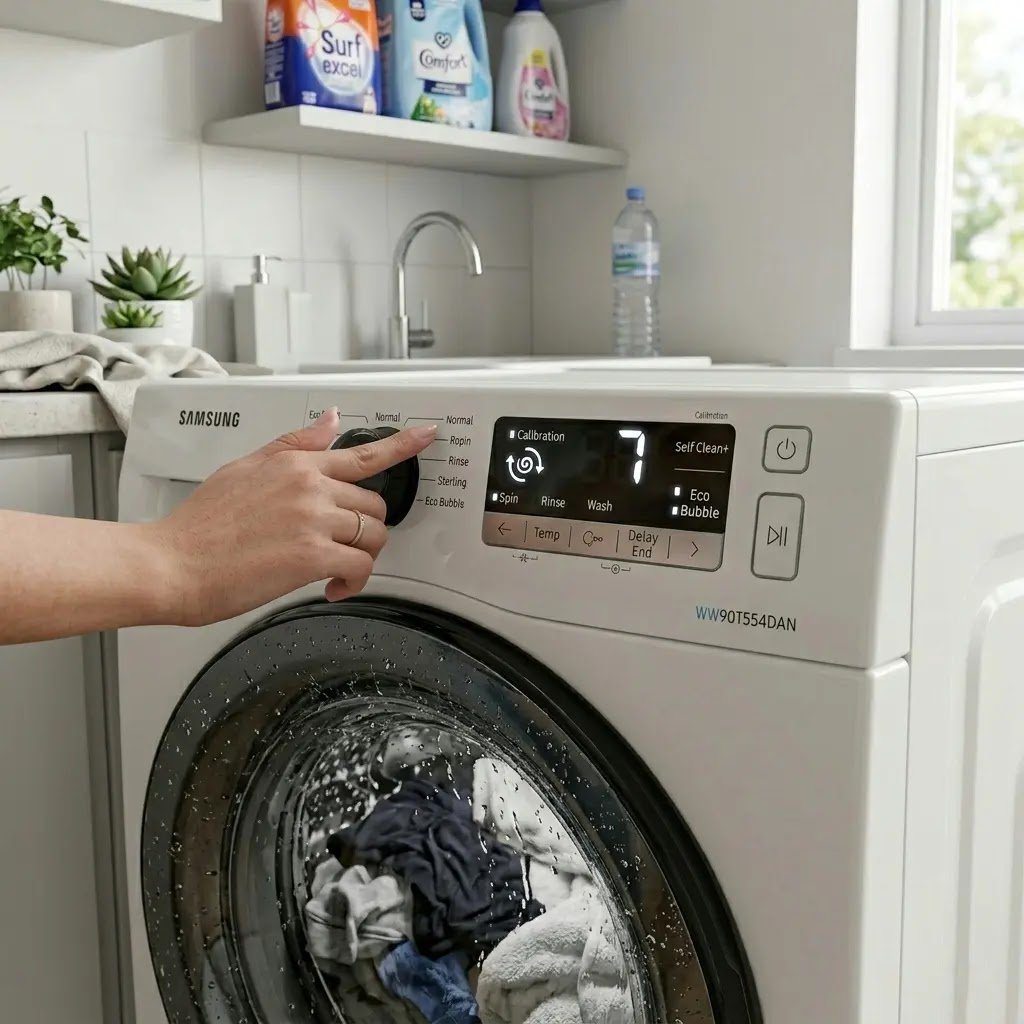
Samsung washing machine not spinning?
Stuck at the 7, 8, or 9-minute mark? Here is why your washer stops and how to reset the sensors in minutes.
The Infinite Loop Reality
Nothing is more annoying than a washer that sits at 7 minutes for an hour while your clothes stay soaking wet. In most cases, your motor is perfectly fine. The problem is usually a confused sensor or a small balance issue that triggers a safety stop. Before you call a repairman, let’s look at the logic behind the stall.
1. Why Does it Always Stop at 7 Minutes?
In Samsung’s software logic, the 7-to-9-minute mark is the final handshake. This is when the machine’s brain (the PCB) checks two things before it allows the drum to spin at high speed (1200+ RPM):
- Is the Load Balanced? If a heavy towel or bedsheet is stuck on one side, the machine won’t spin to prevent it from walking across your laundry room.
- Is the Tub Empty? If the water hasn’t drained completely, the machine will wait indefinitely rather than spinning with water inside.
2. How to Recalibrate Your Samsung Washer

Think of calibration as a factory reset for your washer’s balance sensors. Over time, moving the machine or heavy loads can confuse these sensors. Here is how to fix it for both old and new 2026 models:
Is your AI washer stuck before the cycle even starts? Check this: Samsung AI Washer Stuck on Calculating? Fix the load sensor loop.
Method A: For Dial & Button Models
- Empty the drum completely.
- Press Power to turn the machine on.
- Hold Temp. and Delay End together for 3 seconds.
- When Cb appears, press Start.
Method B: For AI & Touchscreen Models
- Tap the Settings (Gear) icon on the screen.
- Scroll down to Calibration.
- Select Start and ensure the door is locked.
- The drum will spin for 2-3 minutes until 0 or End appears.
3. Front-Load Samsung Washers: The Gravity Challenge
Front-load machines are masterpieces of efficiency, but they have a natural enemy: Gravity. Because the drum sits horizontally (lying down), the clothes are constantly being lifted and dropped. When the machine hits the 7-minute mark, it tries to distribute the clothes evenly around the circle of the drum.
Why your front-loader stalls:
- The Single Item Trap: If you are washing one heavy bathrobe or a single pair of jeans, the machine cannot spread the weight. It will keep tumbling slowly, trying to find a balance that doesn’t exist.
- Shock Absorber Fatigue: Front-loaders have 2 to 4 shock absorbers at the bottom. If these leak oil or lose tension, the drum will shake violently. Samsung’s VRT (Vibration Reduction Technology) sensors will detect this and immediately kill the high-speed spin to protect the outer tub.
4. Top-Load Samsung Washers: The Suspension Struggle
Top-load machines operate on a pendulum system. The entire heavy drum is literally hanging from four thin metal rods (suspension rods) located in the corners of the cabinet. This design allows the drum to move freely, but it is much more prone to the Death Wobble.
Why your top-loader stalls:
- The Tub-Hit Sensor: In top-loaders, there is often a physical lever or a digital 3D sensor that detects if the drum is hitting the sides of the machine. If your machine is unlevel or the rods are weak, the drum will lean to one side, triggering the UE (Unbalanced Error) code instantly.
- Liquid Balance Rings: Samsung top-load drums have a plastic ring at the top filled with a special fluid. If this ring leaks or cracks, the drum loses its counterweight, and the machine will refuse to spin because it can no longer balance itself.
Quick Summary: Which one do you have?
If your door is on the front, your 7-minute stall is likely caused by shock absorbers or a single heavy item.
If your door is on the top, your 7-minute stall is likely caused by weak suspension rods or the machine not being perfectly level on the floor.
5. The Drain Timeout: 1 Inch of Water Stops Everything

Samsung washers are designed with a strict safety timer. When the cycle reaches the 7-minute mark, the computer checks if the drum is bone-dry. If there is even one inch of water left, the machine will refuse to spin. Why? Spinning a drum full of water at high speed can destroy the motor bearings.
How to Fix a Sluggish Drain:
- The Coin Trap (Emergency Filter): At the bottom front of your machine, there is a small door. Open it, unscrew the filter, and you will likely find coins, hairpins, or lint. If this filter is clogged, the water drains too slowly, and the 7-minute timer times out.
- Check the Wall Drain: Sometimes the clog isn’t in the machine but in your house’s pipes. Ensure the drain hose isn’t pushed too far into the standpipe (it should only go in about 6-8 inches).
Related Reading: If your tub is still full of water, follow our step-by-step diagnostic here: Water Not Draining from a Samsung Washing Machine? Causes & Safe Solutions (2025).
6. Biofilm: The Invisible Enemy of Your Sensors

This is a technical secret most manuals don’t tell you. Your washer has a pressure switch (water level sensor). It is connected to the drum by a thin plastic tube. Over time, hair conditioner, detergent, and skin cells accumulate to form a slimy buildup called biofilm inside this tube.
When this tube gets clogged, air cannot reach the sensor. The machine gets confused; it thinks the drum is full of water even when it’s empty. This causes the 7-minute stall because the brain is waiting for a signal that never comes.
Technician’s Fix: Locate the pressure switch under the top cover. Disconnect the thin tube and blow air through it. If you feel resistance, you’ve just found your problem. Clearing this tube often fixes mysterious spin issues instantly.
7. Hardware Anatomy: Hall Sensors & Drive Belts
If calibrating and cleaning the filter didn’t work, we have to look at the machine’s muscles. In 2026 models, the technology is more durable, but the two main parts can still fail:
- The Hall Sensor: This is a tiny chip on the back of the motor that tells the computer how fast the drum is spinning. If it gets dusty or loose, the computer loses track of the drum speed and stops the spin cycle for safety.
- The Clutch/Shifter: In top-load models, this part physically switches the motor from Agitate (washing) to spin. If you hear a loud clunk or a grinding noise but no spin, the shifter is likely broken.
Frequently Asked Questions (FAQs)
Q1: Why does my Samsung washer jump from 7 minutes back to 15?
Answer: This is called auto-correction. The machine detected an unbalanced load and added more time to fill with water and try to redistribute the clothes. If it happens repeatedly, your suspension rods or shock absorbers are likely weak.
Q2: Can using too much detergent cause a spin failure?
Answer: Yes. Over-sudsing (too many bubbles) tricks the sensors into thinking the drum is still full of water. Always use HE (high efficiency) detergent and stick to the recommended amount to avoid sensor confusion.
Q3: How do I know if my motor is actually dead?
Answer: Motors rarely die suddenly. If the drum moves during the wash cycle but not the spin cycle, your motor is fine. A dead motor usually results in zero movement and a specific 3E or 4E error code on the display.
Q4: Is it worth repairing a 10-year-old Samsung washer?
Answer: If the repair is a simple filter clean or calibration, yes. However, if the main PCB (control board) or the tub bearings are damaged, the repair cost might be 60% of the cost of a new 2026 AI-powered model. In that case, upgrading is usually the smarter financial move.
Final Verdict: The 10-Minute Fix
Most Samsung spin issues are software or balance-related, not mechanical failures. By following the calibration (Cb) steps, cleaning your drain filter, and performing the bounce test, you can solve 90% of these problems without spending a penny on a technician. Keep your loads balanced and use the right detergent, and your machine will serve you well for years to come.
Want to prevent the 7-minute stall in the future? Read the 2025 Maintenance Master guide