
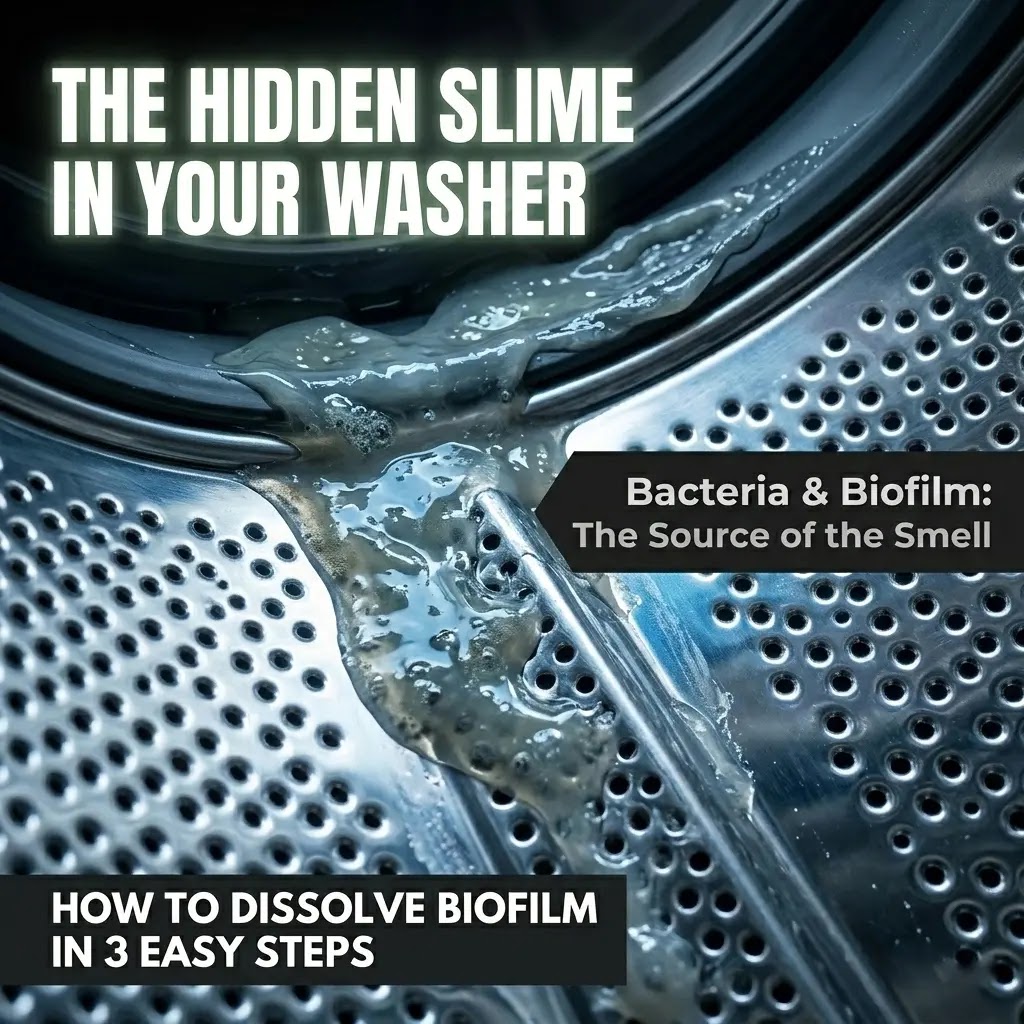
You ran your washer cleaner exactly as directed, hot water, full cycle, name-brand tablet, and the machine still smells like a gym bag left in the rain. That’s not user error. Most washer cleaner products are built to soak a surface, not scrub one, and what’s actually growing inside your drum isn’t dirt at all. It’s a living colony called biofilm, and understanding why your washer cleaner failed against it is the first step to actually killing it for good.
Table of Contents
1. The Invisible Jelly (The Science of Biofilm)
Think of biofilm as the plaque that builds up on your teeth overnight. You cannot remove it just by rinsing your mouth with water; you must use a brush to physically scrub it away.
In your washing machine, a similar invisible jelly grows on the surfaces you cannot see. This biofilm is a complex colony of bacteria and mold protected by a slime shield called EPS. While some modern machines claim to tackle this with technology, many users still ask: 👉 UV & Ozone: Do Portable Washers Actually Kill Bacteria?], or is a chemical scrub still the only way? It develops in five distinct stages, eventually releasing pieces of the colony to contaminate your clean clothes.
2. Why Cleaning Tablets Often Fail+
Cleaning tablets provide a soak, but they do not provide a scrub. If the biofilm layer is mature, the chemical solution may simply wash over it. Here are the primary reasons for failure:
- Low Water Levels: Modern High-Efficiency (HE) machines, common on Samsung, LG, and Whirlpool front-load models alike, use very little water. The cleaning solution often fails to reach the upper parts of the outer tub, where mold grows, since the tablet was designed assuming full submersion.
- Temperature Requirements: Most tablets rely on sodium percarbonate, which needs sustained heat above roughly 60°C to activate fully. A quick or eco-mode “clean cycle” often doesn’t hold that temperature long enough. If you are debating between store-bought options or home remedies, our guide on 👉 [Affresh vs. DIY Washer Cleaners (2026): Which Cleans Better?] explains which one actually breaks through the residue.

3. The Spider Arm Corrosion (Financial Risk)
The Spider Arm is the aluminum support stand behind the drum. Biofilm and soap scum collect here, and the acidic environment slowly eats away at the metal. This is often compared to how termites destroy wood.
If this part breaks, the repair is extremely expensive. It is often a sign of deeper mechanical fatigue, so it helps to know about 👉 [Washing Machine Repair: Spotting Faulty Motors Before They Fail] to prevent a total machine breakdown.

The Physics of Failure: Galvanic Corrosion
The Spider Arm is made of aluminum, while the drum is stainless steel, two dissimilar metals with different electrochemical potentials. When biofilm and detergent residue sit trapped between them, the damp organic layer acts as an electrolyte bridge, exactly like the paste in a battery. This completes a circuit between the two metals, and the aluminum, being the less noble metal, sacrifices itself, slowly dissolving until the arm snaps and effectively totals your machine.
| Repair Type | Estimated Cost (USD) |
| Spider Arm replacement | $350 – $900 |
| Main Control Board | $200 – $500 |
| Drum Bearing Assembly | $300 – $500 |
| New HE Machine | $700 – $1,500 |
Note: If repair quotes exceed 50% of a new machine’s price, technicians usually advise replacement.
4. The Technician’s Two-Stage Eradication Strategy
Biofilm is a double-layered enemy. It has an organic slime shield (bacteria) and a mineral backbone (limescale). You cannot kill it with one chemical. You must use the two-stage punch:

Stage 1: The Alkaline Punch (Organic Break)
Use 1 cup of sodium percarbonate (oxygen bleach) or a high-quality tablet in a 90°C (194°F) sanitize cycle. This dissolves the fatty slime shield (EPS) that protects the bacteria.
Stage 2: The Acid Flush (Mineral Dissolve)
Run a second, separate cycle with 200g of citric acid powder. This dissolves the calcium and limescale anchor that holds the biofilm to the metal drum.
Critical Rule: Never mix these two chemicals in the same cycle. They will neutralize each other and become useless salty water.
5. The Drain Trap (Safety Check)
The drain pump filter catches lint, coins, and stagnant water. If not cleaned, it rots and releases a sewage or sulfur smell, a different symptom from drum biofilm, but one that often gets blamed on “the cleaner not working” when it’s really a separate trap issue.
👉 How to Clean Your Washing Machine Drain Filter Safely perform the full step-by-step process, including how to drain residual water without flooding your floor.
If your machine stops mid-cycle with a code, refer to 👉 [LG Washer Repair Guide: Fix OE Error] to quickly clear the blockage.

Quick Cause Check, Sewer Smell:
If your machine smells like a sewer even after a deep clean, the issue is often siphoning, not biofilm, usually a drain hose sealed too tightly in the standpipe or hooked at the wrong height. 👉 Washing Machine Smells Like Sewage: Siphoning & Drain Hose Fix covers the correct air gap and hose height to fix it permanently.
6. Rules to Prevent Future Buildup
- Use Powder Detergent: Liquid soaps are oil-based and turn into a sticky jelly inside the machine. Powder is more alkaline, which helps stop mold growth.
- Leave the Door Open: Moisture is required for mold and biofilm to flourish. Always leave the door and the detergent drawer open after washing.
- Avoid Fabric Softener: Softener is essentially liquid fat for your machine. It leaves a waxy layer called scrud that traps dirt and feeds bacteria. Use wool dryer balls or a little white vinegar in the rinse cycle instead.
7. Helpful FAQs
1. Is vinegar safe for regular maintenance washes?
While it can remove light odors, vinegar can penetrate rubber seals and cause them to crack over time. Citric acid is generally safer and stronger for descaling.
2. Why does my machine smell like rotten eggs?
This is usually hydrogen sulfide gas released from stagnant water in the drain filter or standpipe. Cleaning the filter and flushing the drain usually fixes the problem.
3. How often should I clean my machine?
Experts recommend a deep maintenance wash every 30 cycles or once a month. In hard water areas, every two weeks is ideal, since mineral buildup accelerates the biofilm’s mineral anchor layer.
4. Can I use both citric acid and sodium percarbonate together to save time?
No, this is worth repeating. Mixing them in the same cycle neutralizes both chemicals into inert salty water, wasting the product and leaving the biofilm untouched. Always run them as two separate, sequential cycles.
5. Will hot water alone kill biofilm without any chemicals?
No. Heat alone can kill some bacteria, but it doesn’t dissolve the EPS slime shield or the mineral anchor holding the colony in place. Without the chemical breakdown, dead bacteria and their protective layer simply stay stuck to the drum.
6. Does a self-clean or tub-clean cycle already handle biofilm on its own?
Partially. A tub-clean cycle provides the hot water and agitation, but it’s only as effective as what you put in it, running it empty with no cleaner does little for mature biofilm. Pair it with the two-stage strategy above for a real result.
7. How do I know if spider arm corrosion has already started before it fails completely?
Early signs include a faint metallic or “battery” smell during spin, rust-colored streaks on the inside of the drum near the back, or a new grinding noise that wasn’t there before. Catching it at this stage is far cheaper than waiting for the arm to snap.
8. Conclusion Summary
Most washer cleaner products fail for one simple reason: they’re built to dissolve, not to scrub, and biofilm doesn’t respond to soaking alone. It has two defenses, an organic slime shield and a mineral anchor, and a single-chemical washer cleaner can only ever break down one of them, leaving the other fully intact to rebuild the colony within days.
That’s why the two-stage approach matters more than which brand of washer cleaner sits on your shelf. Sodium percarbonate strips the organic shield; citric acid dissolves the mineral anchor holding what’s left onto the drum and spider arm. Run them as separate cycles, once a month, and you’re not just fighting smell; you’re protecting a $350–$900 part from the galvanic corrosion that biofilm quietly causes over time.
Skip this maintenance, and the cost isn’t just odor; it’s a corroded spider arm, a failed bearing, or a control board damaged by trapped moisture. Twenty minutes of prevention a month is cheaper than any of those repairs.