
Table of Contents
1. Introduction: The UV Light & Ozone Secret: Do Portable Washers Actually Kill Bacteria?
We’ve all been there, taking a load of laundry out of a portable washer and smelling that fresh mountain breeze scent. It feels great, but I have some tough news: just because your clothes smell good doesn’t mean they’re actually clean. In a full-sized industrial machine, we rely on heavy heat (60°C to 90°C) to literally melt the proteins of bacteria and viruses. Portable washers, however, are usually built to run on cold water to keep power usage low. This gap between looking clean and being biologically safe is what I call the clean illusion. Without heat, skin oils and bacteria often survive the cycle, just waiting to multiply once the clothes hit the drying rack.
2. The Blue Light Mystery: Marketing or Medicine?

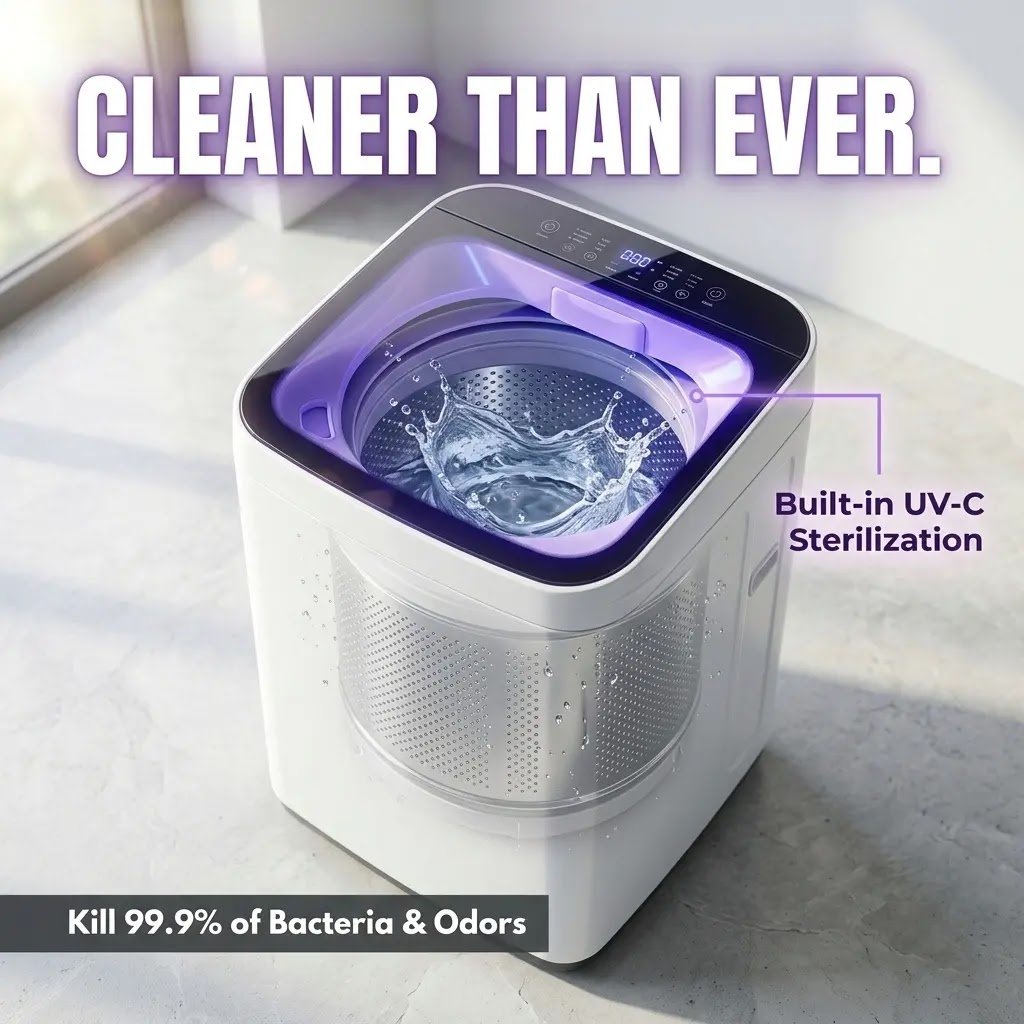
Browsing Amazon for a portable washer usually reveals a glowing interior that looks like a high-tech lab. But let’s look at the physics before we get excited:
- UV-C Light (The Reality): For light to kill a germ, it has to be in the 200 nm to 280 nm range. This light is strong enough to scramble a bacterium’s DNA so it can’t reproduce.
- Blue LEDs (The Marketing): Most affordable washers use standard blue LEDs (around 450-470 nm). These look cool, kind of like a disco party in your room, but they have zero germ-killing power.
The truth is, real UV-C is dangerous for humans; it can cause skin burns and eye damage, so it has to be kept in a completely sealed, light-proof box. If you can see that blue light through a clear lid while the machine is running, it’s almost certainly decorative. Furthermore, light can’t kill what it can’t see. If a germ is hidden in a shadow or the fold of a t-shirt, the light won’t touch it.
[!WARNING]
DIRECT EXPOSURE HAZARD: > If your portable washer uses genuine UV-C light (not just decorative blue LEDs), never look directly at the light while the machine is running. UV-C radiation can cause permanent retinal damage and skin burns. Always ensure the lid is opaque or has a UV-filter coating before operation.
3. Ozone (O₃) Tech: The Invisible Cleaner

If light is a spotlight, ozone (O₃) is a gas that fills the whole room. Often called Super Oxygen, it’s a powerhouse for natural cleaning.
How it works: Ozone is a highly reactive molecule that attacks the cell walls of microbes, causing them to literally pop. It breaks down odors and organic grime at a molecular level without needing any bleach or chemicals.
Buyer Beware: If you’re looking for an ozone washer, ignore the ones with bubble stones at the bottom. In a shallow, 12-inch water drum, those bubbles just float to the top and escape as gas, sometimes irritating your lungs. You want a Venturi injection system, which mixes the ozone into the water before it ever enters the tub. This ensures the water itself is the cleaning agent.
[!CAUTION]
RESPIRATORY SAFETY: > Ozone is a powerful oxidizer. If you smell a sharp, bleach-like odor during the cycle, ensure your laundry area is well-ventilated. High concentrations of ozone gas can irritate the lungs and trigger asthma. If you use an external ozone generator, never breathe in the gas directly from the tube.
4. The Scientific Gap: Mechanical Action vs. Sanitization
Even the most advanced ozone or UV setup will fail if your machine can’t handle the bio-load, which is a fancy way of saying mud, dirt, and skin cells. Bacteria often hide underneath layers of physical soil, creating a protective shield that light and gas can’t penetrate.
- Agitators win on dirt: Portable washers with a tall central agitator provide aggressive scrubbing, which is essential for removing heavy mud.
- Impellers are for light soil: The flat discs (impellers) are gentler on fabrics but might leave enough dirt behind to protect surviving germs.
For a wash to be truly hygienic, the machine must first mechanically blast the dirt out of the fibers so the sanitizing ozone can actually reach the bacteria. If the machine leaves mud on your jeans, it’s leaving germs, too.
[!STOP]
TOXIC GAS CLOUD: > Never, under any circumstances, mix Bleach with Vinegar (Acetic Acid) or Ammonia. This combination creates Chlorine Gas, which is highly toxic and can be fatal if inhaled in a small, enclosed space like a bathroom or laundry closet. Always rinse the machine thoroughly between using different cleaning agents.
5. The Small Drum Trap: Why Biofilm Loves Plastic
Portable washers are almost always made of plastic polymers like polypropylene. While the plastic feels smooth to your hand, under a microscope, it’s full of tiny pits and ridges.
- The Slime Cycle: Soap scum, body oils, and dead skin get trapped in these microscopic holes, forming a biofilm, a sticky, slimy layer that acts as a fortress for bacteria.
- The Persistence: Once this biofilm takes hold, normal detergent can’t wash it away. This is why a machine might start to smell sour even if you’re using plenty of soap.
6. Skin Health & Allergies (The 2026 Perspective)
By 2026, skin sensitivity will have become a major concern for consumers. Portable washers are known for having weaker rinse cycles than full-sized machines, which often leaves detergent residue deep in the fabric fibers.
The Solution: This is where ozone really shines. Aqueous ozone helps neutralize synthetic surfactants and leftover chemicals from your soap. This results in softer clothes and a huge reduction in skin rashes for people with eczema or for babies with ultra-thin skin.
7. 2026 Tech: Ultrasonic Vibration Washers

We’ve seen a massive rise in sink-based washers that use high-frequency sound waves (20-40 kHz) instead of a spinning drum.
Bubble Implosion (Cavitation): These waves create millions of microscopic vacuum bubbles that implode (cavitation), creating tiny shock waves that blast soil off fabric. It’s incredible for delicate items like silk, causing 50\% less fiber damage than a rotating drum. But here’s the catch: it’s useless for heavy denim or towels, as thick fabric absorbs the sound waves before they can reach the center.
8. The Temperature Reality Check: Plastic and Leaching
You might be tempted to pour boiling water into your portable washer to kill germs, but stop right there. Most portable plastic tubs aren’t built for that heat.
Chemical Leaching: High temperatures (especially above 45°C) can speed up the leaching of chemicals like BPA or phthalates from the plastic drum into your water and clothes. To stay safe, always aim for a warm wash (40°C) balance. This is hot enough to help the soap work without breaking down the machine’s plastic integrity.
[!DANGER]
STRUCTURAL INTEGRITY & TOXICITY: > Never pour boiling water (100°C) into a plastic portable washer. Most units are rated for a maximum of 50°C to 60°C. Boiling water can warp the plastic drum, melt the rubber seals, and cause harmful chemicals like BPA or phthalates to leach into your clothing. Stick to warm settings for safety.
9. Real-World Evidence: The Reddit Stink Test
If you check any laundry forum, you’ll see users complaining about clothes smelling musty after two days. I’ve researched the physics, and the culprit isn’t the wash; it’s the spin cycle.
Most portable units spin far too slowly, leaving clothes at about 80\% moisture. If your clothes take more than 8 hours to dry, you’ve created a perfect incubator for bacteria. To stop the smell, you need a high-speed spinner to get the fabric as dry as possible, as fast as possible.
10. Detailed Model Comparison: Which Actually Works?
Ozone Leader
Panda PAN50SWF2 (1.7 cu. ft)
This fully automatic model is famous for its stainless steel drum and multiple spin speed settings. It includes a dedicated sanitize rinse mode that uses optimized water flow to strip away both dirt and detergent residue.Dual-Tub Utility
Costway 24731US (With Heat)
One of the few portables that actually includes a 4-level heating function. It allows you to wash in safely warm water and keeps the wash and spin tubs separate to prevent recontamination from the dirty wash water.
11. Technology Comparison Table
| Feature | UV-C Light | Ozone (O ₃) | Ultrasonic Waves |
|---|---|---|---|
| Primary Goal | Killing the DNA of Bacteria | Odor removal & Bleaching | Micro-fiber cleaning |
| Best For | Exposed Surface Germs | Gym Clothes & Odors | Silk & Very Delicates |
| The Downside | Shadows stay dirty | Can be harsh on rubber | Fails on heavy denim |
12. The No-Physics Maintenance Trick
You don’t need fancy tools to keep your machine hygienic. Just follow this once-a-month routine:
- Step 1: The Acetic Soak: Fill the machine with warm water and 2 cups of white vinegar. Start a cycle, then pause it for 60 minutes. The acid will melt the soap slime and dissolve any mineral buildup.
- Step 2: The Air-Dry: This is the most important part. Always wipe the drum dry and leave the lid open after every single use. Bacteria need moisture to grow; by keeping it dry, you kill them without using a single chemical.

13. Frequently Asked Questions (FAQs)
Q: Why do my clothes still have white streaks after a wash?
A: You’re likely using way too much soap. Portable washers use much less water, so excess detergent doesn’t rinse out properly. Switch to a single tablespoon of HE liquid detergent to avoid skin irritation.
Q: Is it safe to use 90°C boiling water in my portable machine?
A: No! Boiling water can warp the plastic or cause harmful chemicals to leach into your clothes. Stick to 40°C–50°C for a safe, effective clean that won’t ruin your machine.
Q: Can I use UV light and ozone together?
A: Yes. In fact, they work best as a team. UV kills germs on the surface instantly, while ozone gas reaches into the deep shadows and folds that light can’t touch.
Q: My machine has a blue light, but it still smells like mildew. Why?
A: Your blue light is likely just a decorative LED. If the machine smells, it means there’s a biofilm fortress built up in the plastic that needs a deep vinegar flush.
14. Conclusion: Summary of Results
True hygiene in a portable washer isn’t about fancy neon lights; it’s about the science you can’t see. To get real results, you need to break down the bio-load with strong mechanical agitation, sanitize chemically with ozone, and spin your clothes at high speeds so they dry before bacteria can grow back. If you stay on top of your vinegar maintenance and choose a machine with a real ozone system or a high-RPM spinner, you can finally trust that your clothes are as clean as they smell.
🚀 Portable Laundry: Beyond the Science
Now that you understand the UV and Ozone physics, ensure your tiny-home setup is efficient and leak-free with our 2026 field guides:
→ 2026 Buyer’s Guide: 5 Best Portable Washers for Tiny Apartments Our top lab-tested picks that balance mechanical agitation with genuine sanitization features.
→ No-Plumbing Hacks: How to Install Your Portable Washer Anywhere 3 genius ways to connect your machine to any sink or bucket without permanent plumbing.
→ Portable Washer-Dryer Combos: 7 Brutal Truths You Must Know The honest reality of drying times, lint buildup, and why some combos never truly get clothes dry.