
Table of Contents
Mastering the art of slim-profile storage for a fresher kitchen.
1. Introduction: The 70% Rule: Why Your Counter-Depth Fridge is Failing
Counter-depth refrigerators are loved for their sleek look that matches kitchen cabinets, but they come with a hidden challenge: you lose about 6 inches of interior depth. Many people struggle because they try to use this thin space the same way they used their old, deep fridge. To make it work, you have to stop hoarding and start organizing. By using the right strategy, you can fit a standard amount of food while keeping everything fresher than ever before.
2. The Physics of Cold Air (The 70% Rule)
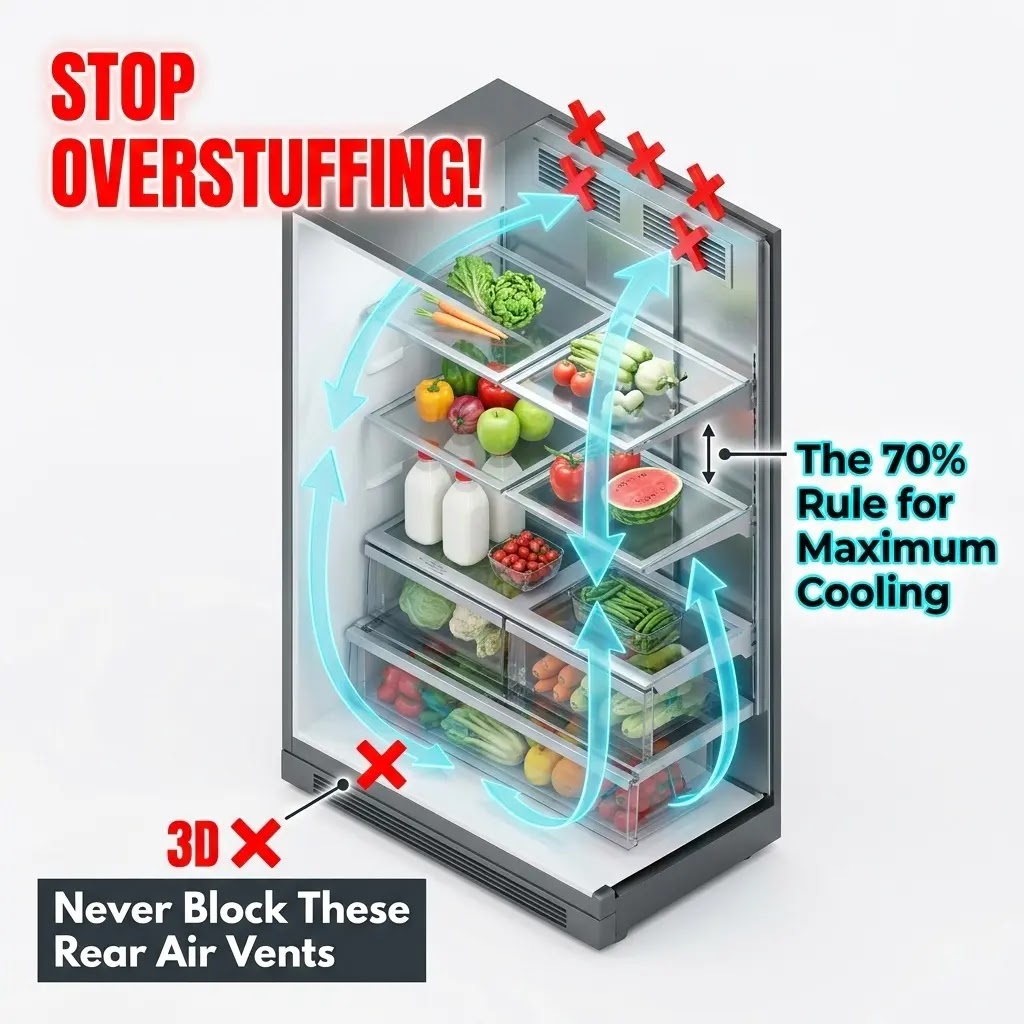
In a thin fridge, the distance between the back wall and the door is very small. This leads to the Airflow Trap.
- The Trap: If you pack items too tightly against the back wall, you block the cooling vents. Cold air gets stuck at the back, freezing your produce, while items near the door stay too warm and spoil quickly.
- The 70% Rule: Never fill your fridge more than 70% full. You need to leave 30% of the space empty so cold air can move in a loop. This ensures every item stays at a safe, even temperature.
3. Ethylene Gas Management: Protecting Your Produce
Because counter-depth fridges have less space, fruits and vegetables sit much closer together. This is dangerous because many fruits emit ethylene gas, a natural ripening hormone that can cause nearby vegetables to rot prematurely.
- The Emitters: Apples, pears, peaches, and avocados are high emitters. If you store them next to sensitive produce like broccoli, lettuce, and cucumbers, those vegetables will turn yellow and soft in days.
- The Fix: Use Produce Saver Bins with carbon filters (like OXO GreenSaver) to absorb the gas. If you don’t have bins, keep emitters in a separate crisper drawer with the vent set to Low Humidity to allow the gas to escape.

4. Temperature Mapping & The Milk Rule
Not every spot in your fridge is the same temperature. Understanding this map is critical for food safety.

The Milk Rule: Never store milk in the door. The door is the warmest part of the fridge, and the temperature fluctuates every time you open it. Studies show that milk stored at 42°F (a common door temperature) spoils twice as fast as milk kept at 35°F on a back shelf. Store your milk and dairy on the bottom shelf toward the back, where it is consistently the coldest.
5. The Condiment Trap: A 6-Month Audit
People often fill their door bins with sauces they rarely use. Over time, these expired bottles take up the most accessible real estate in your fridge.
- The Audit: Every 3 to 6 months, pull everything out of your doors. If you haven’t used a sauce in 3 months and if it has expired, toss it.
- Door Logic: Reserve your doors for items with high preservatives that can handle temperature changes, like mustard, jelly, and pasteurized juices. This frees up shelf space for fresh food.
6. The Stacking Danger: Respect the Weight Limits
In a small fridge, the temptation to stack heavy glass containers is high. However, residential glass shelves are not indestructible.
- Weight Limits: Most standard glass refrigerator shelves are designed to hold between 20 and 50 pounds. Samsung and LG shelves are often built to support a maximum of about 57 lbs (26 kg), but placing that much weight in the center can cause the glass to flex and the plastic brackets to crack over time.
- Airflow Impact: Stacking items to the ceiling doesn’t just risk breaking a shelf; it also blocks the top evaporator fan, which needs at least 4 inches of clearance to push air effectively through the unit.
7. The Geometry of Modern Storage
A shallow fridge is a gift if you use Lateral Organization. Since items can’t hide in the back, keep them in the front row.
- Slim Bins: Use clear bins that are under 14 inches deep. They act as drawers, so you can pull out the breakfast bin and snack bin in one motion.
- Lazy Susans: Use a 9-inch spinning tray in the corners. This brings jars from the back to your fingertips and prevents them from blocking the rear air vents.

8. Solving the Large Item Mystery
Fitting a whole turkey and a pizza box is a common worry, but your fridge has built-in solutions.
- Slide-Back Shelves: Use the cantilever feature to slide the front half of a shelf under the back half. This creates a tall space for big items without moving everything.
- The Pizza Hack: A 16 to 18-inch pizza box will not fit flat. Cut the box in half and stack the two halves, and transfer slices to foil. Foil takes up 90% less space and keeps the pizza fresher than cardboard.

9. Frequently Asked Questions (FAQs)
Q: Why are my carrots turning bitter and my lettuce wilting so fast?
A: You are likely storing them near ethylene-producing fruits like apples and pears. The gas speeds up decay. Keep them in separate drawers and use carbon filters.
Q: Can I put my cast-iron pot directly on the glass shelf?
A: Be careful. A heavy pot plus its contents can easily reach 40 lbs. While shelves are rated for 50 lbs, placing all that weight directly in the center can cause the glass to shatter and the plastic clips to snap.
Q: My fridge is noisy and not cooling well. Is it broken?
A: Check if you’ve stacked items too high on the top shelf. If you block the fan (leave 4 inches of space), the fridge will work harder and make more noise.
10. Conclusion: Efficiency Over Capacity
A counter-depth fridge is a lifestyle choice that values an organized, fresh kitchen over bulk storage. To succeed, remember:
- Respect the 70% Rule: Leave 30% empty for airflow.
- Separate Emitters: Keep gas-producing fruits away from sensitive vegetables.
- Map Your Cold: Keep milk in the back of the bottom shelf, never in the door.
- Audit and Weigh: Clear out old condiments every 6 months and avoid overloading fragile shelves.
By treating your fridge as a high-efficiency processing center rather than a vault, you’ll find that a slim profile offers more than enough room for a busy, healthy household.
📐 Counter-Depth Optimization Toolkit
Is your slim-profile fridge still underperforming? Explore these 2026 field guides to master the style, fit, and technical maintenance of your appliance:
→ Cooling Error? How to Properly Reset Your Fridge The specific button sequences to clear ‘Ghost Codes’ after a power flicker or sensor glitch.
→ The $500 Sleek Tax: Is Counter-Depth Actually Worth It? A deep dive into the engineering and pricing myths behind the most popular kitchen trend of 2026.
→ Fit Issues Fixed: Stop Your Fridge from Suffocating If your unit is running hot or making noise, you might have a ventilation or door-swing clearance issue.