
Table of Contents
1. Introduction: 5 compact Portable Washing Machines
Living in a 400-square-foot apartment in 2026 means every inch of space counts. For most urban dwellers, the weekly laundry day is a major source of stress. It usually involves carrying heavy, dirty bags to a basement or a neighborhood laundromat. This laundry tax takes away your free time and costs you $30 to $50 every month. Even worse, shared building machines are often dirty, broken, or full of other people’s clothes.
A portable washing machine is the best life hack for 2026. These machines are not just for camping anymore. They are powerful, smart, and designed to fit into tiny closets or under bathroom sinks. This guide will take you through everything you need to know, from how they connect to your kitchen tap to which specific model will fit your laundry habits and your budget.
2. What Exactly is a Portable Washer?
A portable washer is a simplified version of a regular washing machine. It does not need permanent pipes or a professional plumber. It is a mobile appliance that uses your existing home setup to get clothes clean.
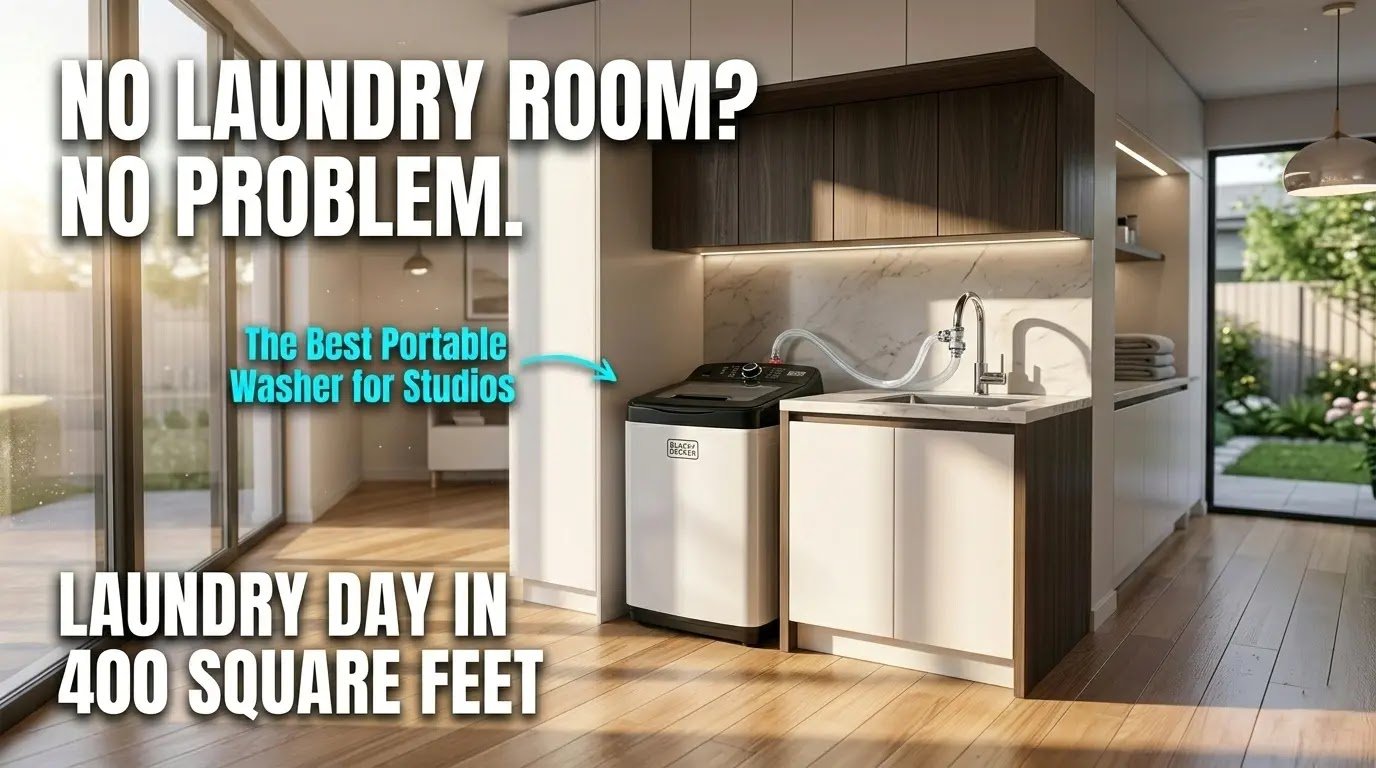
- The Sink Connection: Instead of fixed pipes, you use a Quick-Connect Adapter. This silver part screws onto your sink faucet (tap). You then click the machine’s water hose onto the adapter, allowing water to flow directly into the drum.
- The Drain Pump: When the cycle is done, the machine needs to get rid of dirty water. Most 2026 models have an internal pump that pushes water through a hose. You put this hose into your sink, your bathtub, or a floor drain.
- The Size: Standard machines are 30 inches wide. Portable ones are usually 17 to 24 inches wide. Many weigh less than 50 pounds and have wheels, so you can roll them into a closet when they are not in use.
3. Who Should Actually Buy One?
If you fit into one of these three groups, you will likely see a massive improvement in your quality of life:
- Apartment Renters: If your landlord does not allow you to install a permanent washer, a portable unit is your loophole. Since it connects to a sink and can be moved, it is often viewed as a temporary appliance like a microwave.
- Budget-Minded Students: Paying $4 per load adds up quickly. A $200 machine pays for itself in roughly 7 months of use. After that, your laundry is essentially free.
- Hygiene-Conscious Users: Sharing machines with hundreds of strangers can be gross. Having your own drum ensures that only your dirt is in the machine.
4. Key Features to Check (The No Jargon Guide)
The Load Reality: Manufacturers list capacity in cubic feet, which is hard to imagine. In 2026, we measure by what actually fits :
- ⭐ 0.9 Cu. Ft.: 4-5 T-shirts OR 2 pairs of adult jeans.
- ⭐ 1.6 Cu. Ft.: 3-4 pairs of jeans OR 2 large bath towels.
- ⭐ 2.8 Cu. Ft.: 10-12 pairs of jeans OR a queen-size thin blanket.
Spin Power: The spin cycle is the most important part if you don’t have a dryer. Faster spinning means dryer clothes. High-end portables reach 750 to 800 RPM. High-speed spinning creates a powerful centrifugal force that pulls water out of the fabric fibers.
Drum Material: Only buy machines with Stainless Steel drums. Plastic drums can chip and snag delicate clothes. Stainless steel stays cleaner and lasts much longer.

5. Top 5 Portable Washer Models for 2026 (Detailed Reviews)
Model 1: Black+Decker 0.9 Cu. Ft. (BPWM09W): The Best Overall

This is the most popular model in 2026 for a reason: it balances price and performance perfectly.
Technical Specs: It uses 300 watts of power and weighs 48.4 lbs. It is roughly 17.7 inches wide and 31.1 inches tall. The body is made of metal, not thin plastic, which makes it very stable during the fast spin phase.
Why It Wins: It features an Impeller system (a low-profile cone at the bottom) instead of a tall agitator. This creates a tornado of water that pushes clothes against each other to rub dirt away. This is much gentler on your clothes than the old-fashioned shredding agitators. It also has Auto Unbalance Detection. If your clothes bunch up on one side, the machine stops to prevent itself from walking across your floor.
The Load Reality: Best for 1-2 people. It can clean 3 shirts, 1 bath towel, and several pairs of socks in one load comfortably.
Model 2: Super Deal Twin Tub – The Budget Champion

If you want to spend less than $150, this is the cult favorite. It is a semi-automatic system that gets the job done fast.
Technical Specs: It weighs only 22 lbs, making it the easiest to move. It has two separate tubs: a 9.9 lb wash tub and a 4.4 lb spin tub. The spin tub is incredibly fast, reaching 1300 RPM, faster than many full-sized machines.
The Catch: You have to be the manager. You fill the wash tub with a hose, let it wash for 15 minutes, then manually move the wet clothes into the spin tub. It uses a Gravity Drain, meaning the hose must be lower than the machine for the water to flow out. Reddit users often suggest putting it on a small stand or inside your bathtub to help it drain.
The Load Reality: It can handle about 4-6 pairs of jeans at once in the wash side, but you’ll have to spin them in two smaller batches.
Model 3: iWash AI Countertop – Best for Zero Floor Space

The iWash is the only fully automatic countertop machine available in 2026. It is designed to sit next to your toaster.
Technical Specs: It is only 17.3 inches wide and 14.4 inches tall, fitting under almost all kitchen cabinets. It weighs 42 lbs and is famous for being whisper-quiet at 45 dB during the wash phase. For comparison, a normal conversation is 60 dB.
Advanced Features: It has a Built-in Heater that can heat water to 140°F to kill germs, n perfect for baby clothes or dish towels. It uses AI to sense how heavy your clothes are and automatically picks the right water level.
The Load Reality: This is for small, frequent loads. It fits 1 pair of XL jeans OR 4-5 T-shirts OR a week of baby clothes.
Model 4: GE Space-Saving 2.8 Cu. Ft. (GNW128PSMWW) – The Heavy Duty SPLURGE

If you have a large family or wash bulky items, this is a beast. It is effectively a full-sized washer that rolls on wheels.
Technical Specs: It uses a powerful 1200-watt motor and weighs 99 lbs. It stands 37.4 inches tall. Because it is so heavy, it stays perfectly still on the floor with almost zero vibration.
Why It is Premium: It includes a Unicoupler adapter that lets you connect both hot and cold lines to your sink simultaneously. It features 8 different cycles, including a Sanitize cycle. The basket is designed to float in multiple directions during the spin cycle to absorb any balance issues.
The Load Reality: It can handle 12+ pairs of jeans or a queen-size thin comforter easily.
Model 5: WonderWash – Best for Off-Grid or Emergency

This is a non-electric, manual machine that uses zero power. It has a cult following on Reddit for being indestructible.
Technical Specs: It weighs only 5.7 lbs and uses about 2 gallons of water per load. It cleans clothes using Pressure. As you crank the handle, it creates air pressure inside the sealed drum that forces soap into the fibers.
Why Use It: It cleans a load in under 2 minutes. It is perfect for gym clothes, socks, or underwear. There are no motors or circuit boards to break.
The Load Reality: Fits about 1-2 lbs of laundry (a few T-shirts and underwear).
6. The Installation Journey: Step-by-Step

Setting up your machine the right way is the difference between a helpful appliance and a flooded kitchen. Follow these steps carefully:
Step 1: The Bolt Check (CRITICAL)
When you unbox your machine, do not plug it in yet. Look under the unit or on the back. Most automatic washers have Shipping Bolts or foam blocks inside. These are used to keep the heavy drum from moving while it is on a delivery truck. If you do not remove these, the motor will burn out the first time you try to spin. Reach inside the drum and push it; if it wobbles freely, you are safe. If it is stiff, the bolts are still in.
Step 2: The Faucet Connection
- Remove the Aerator: Unscrew the small mesh tip from your sink faucet. If it is stuck, use a pair of pliers with a towel around the metal to avoid scratching it.
- Choose the Right Threads: Faucets come in many sizes (M18, M22, or M24). Most machines come with a Dual Thread adapter that fits 90% of taps. If your tap has hidden threads, you will need a special adapter key.
- Secure the Seal: Screw on the Quick-Connect adapter. Expert Tip: If it leaks, your gasket (the rubber ring inside) might be too thin. You can buy a thicker rubber O-ring at any hardware store for $1 to create a watertight seal.
Step 3: Leveling the Feet
Centrifugal force causes a machine to shake if it is not flat. If one corner is 1/8th of an inch lower than the others, the machine will dance across the floor and hit your cabinets. Place the machine where you want to use it. Push the corners; if it rocks, it is not level. Turn the Adjustable Front Leveling Leg (usually a screw-like foot) until the machine is rock-solid.
Step 4: The Drainage Setup
The drain hose must be secured. The force of the water coming out of the pump can cause the hose to jump out of the sink. Use the U-shaped plastic brace to hook the hose over the edge of the sink. The Height Rule: Ensure the hose is not draped more than 4 feet high. Most portable pumps cannot push water higher than a standard counter.
7. Expert Maintenance: How to Make it Last 10 Years
Portable washers fail because of two things: mold and overloading. Here is the maintenance schedule you should follow:
- 📅 After Every Load: Leave the lid open. If you close the lid while the drum is wet, mold will grow within 48 hours. Wipe the rubber seal with a dry cloth.
- 📅 Monthly: Run a Maintenance Cycle. Use the hottest water possible and add 2 cups of white vinegar or a dedicated cleaner packet like Affresh. This kills bacteria and removes soap scum.
- 📅 Every 20 Loads: Clean the Lint Filter. It is usually a small mesh bag or plastic tray inside the drum. If it gets full, the machine will stop draining correctly.
8. Power & Water: Common Concerns Simplified
Electricity Consumption: A compact washer usually uses 300 to 500 watts when running. This is significantly less than a hairdryer or a space heater. Safety Tip: Do not use an extension cord. These machines draw a surge of power when the motor first starts. An extension cord can overheat and cause a fire.
Water Temperature: Portable machines have only one intake hose. To get warm water, you must adjust the temperature at your sink tap before starting the wash cycle. Wait! Most experts suggest using Cold Water for 90% of your laundry. It saves energy, stops clothes from shrinking, and protects the internal rubber valves of your machine.
9. 5 Mistakes to Avoid When Buying
- Buying a machine that is too heavy to move. If you have to lift it into a bathtub, get a unit under 30 lbs.
- The Soap Overdose. Portable washers use very little water. You only need 1 or 2 tablespoons of detergent. Too much soap creates a suds explosion that can leak into the electronics.
- Forgetting to measure your faucet. Pull-out sprayers or designer square faucets often cannot fit the adapter.
- Overloading the drum. Never fill the machine more than 75% full. Clothes need room to move to get clean. Overloading also snaps the motor belt.
- Ignoring the floor type. Do not put a washer on a soft carpet. It creates an unstable base and can trap moisture, causing mold in your floor.
10. Community FAQs (Reddit & Quora Expert Tips)
Q: Will my downstairs neighbors hear the vibration? Answer: Yes, the spin cycle produces a rumbly noise that travels through floors. To stay on good terms, place the machine on a thick rubber anti-vibration mat or a piece of plywood. Also, only do laundry during the day (10 AM to 7 PM).
Q: How do I dry my clothes without a dryer? Answer: Use a folding rack and a box fan. Position the fan so it blows air directly through the hanging clothes. This moves the damp air away and helps clothes dry in about 4–6 hours.
Q: My sink is 10 feet away from my outlet. What do I do? Answer: Do not use a power extension cord. Instead, buy a Longer Water Hose. You can find 10-foot or 15-foot water intake hoses at any hardware store. It is much safer to run a water hose across the room than an electric cord.
11. Conclusion: Reclaiming Your Time and Money
Investing in a portable washing machine is the single best way to upgrade a tiny apartment in 2026. – For the Best Value: Choose the Black+Decker 0.9. It is the most reliable set-and-forget machine. – For the Smallest Space: Choose the iWash AI Countertop. It is quiet enough to run while you sleep and fits on a kitchen counter. – For the Fastest Wash: Choose the Super Deal Twin Tub. It is manual, but it cleans and spins clothes faster than any automatic unit. By following the simple installation rules, especially removing shipping bolts and leveling the feet, you will enjoy the luxury of clean clothes in your own home for years to come. It is time to retire the heavy laundry bag and take back your freedom.