Bosch Refrigerator Error Codes List 2026
Modern Bosch 500 and 800 series refrigerators are built with advanced technology that makes them function more like sophisticated computers than basic kitchen appliances. They use a network of high-tech sensors and microprocessors to maintain steady temperatures and keep your food fresh. However, if the system detects an internal problem, such as a mechanical block, a faulty sensor, or a power surge, it will alert you through a digital language of error codes.
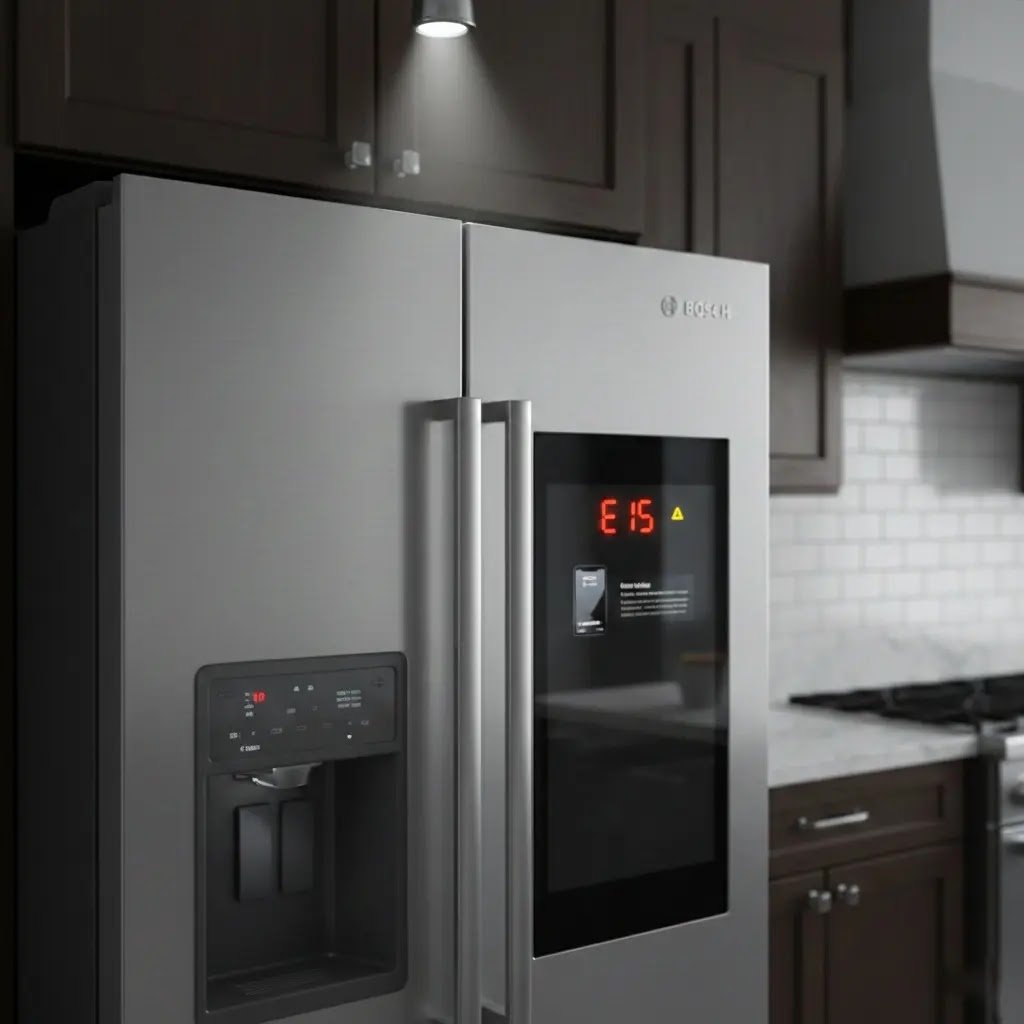
If your refrigerator starts beeping or shows a code like E01 or E15 on its display, there is no need to worry immediately. These codes are the specific language of your appliance, designed to tell you exactly where the problem is located. By understanding these signals, you can often fix the issue yourself and avoid the cost of an expensive service call. This guide explains the most common Bosch error codes for 2026, defines technical terms in plain English, and provides simple DIY solutions.
While Bosch’s computer-like system offers precision, it is more complex than its competitors. You can see how this compares to simpler models in our detailed [Bosch vs. Whirlpool Refrigerator Reliability] guide.
Table of Contents
Quick Diagnostic Reference
Technicians use this table to quickly find the source of a fault. Use it to identify your specific code before following the repair steps below.
| Error Code | Problem Area | Likely Cause | Difficulty Level |
|---|---|---|---|
| E15 | Water/Environment | Moisture in the base or sensor error | Moderate |
| E01 | Fresh Food Sensor | Refrigerator compartment sensor fault | Easy |
| E02 | Freezer Sensor | Freezer compartment sensor fault | Easy |
| E03 | Drawer Sensor | Temperature-controlled drawer error | Moderate |
| E10 | Main Logic Board | Main control board failure or logic glitch | High |
| E11 | Display Board | Interface or display module failure | Moderate |
| E20 | Communication | Wiring error between different boards | High |
| CF | Cooling Efficiency | Condenser fan blocked by dust or debris | Easy |
| dS | Defrost Cycle | The evaporator sensor is loose or shorted | High |
The E15 Error: Water and Environmental Issues
The E15 code is frequently misunderstood because its meaning can vary depending on the Bosch appliance being used. In a Bosch refrigerator, this code typically indicates a fault with the ambient temperature sensor, which informs the fridge about the temperature of your kitchen so it can adjust its cooling cycle accordingly.
However, many Bosch owners also have a Bosch dishwasher. In those machines, E15 means the AquaStop (a safety system designed to shut off water intake instantly if a leak is detected) has been triggered because water is pooling in the bottom tray. If you suspect that moisture has reached the base of your refrigerator, you can use a professional trick called the 45-degree tilt.
Warning: The E15 Band-Aid. The 45-degree tilt is a temporary fix. It drains the water to stop the beeping, but it does not fix the leak. If E15 returns within 48 hours, you likely have a leaking water inlet valve or a pinhole leak in the ice maker line. Do not keep tilting the fridge; find the source of the water before it rots your kitchen flooring.”
How to Perform the 45-Degree Tilt Fix

First, safely disconnect the power and water supply. Carefully pull the appliance out and tilt it backward at a 45-degree angle. This allows any trapped water to drain out of the leak tray onto a towel. You can use a hair dryer on a cool setting to dry the area. Once the internal float switch, a small piece of foam that rises with water, returns to its bottom position, the code should clear when you restore power.
Pro Tip: Safety must always come first. Always unplug the refrigerator before touching any internal wires or panels. Working on a live machine can lead to a dangerous electric shock or permanent damage to the electronic boards.
Sensor Failures and Temperature Stability: E01 to E03
Bosch refrigerators use Negative Temperature Coefficient (NTC) thermistors (sensors that measure temperature by changing their electrical resistance; as it gets warmer, the resistance drops) to monitor cooling.
Troubleshooting E01 and E02 Codes

E01 refers to the fresh food compartment sensor, while E02 refers to the freezer sensor. Often, these sensors are not actually broken. Instead, electrical noise from a loose wire harness (the bundle of wires that connects parts to the main computer board) causes a bad signal.
You can test these sensors using a multimeter (an electronic tool used to measure resistance or test if parts have electricity). A working sensor should show about 7.1 kΩ of resistance at room temperature (77°F). If the reading shows OL (Open Loop), the sensor has failed and must be replaced. To do this, remove the sensor cover on the rear interior wall, unplug the old harness, and snap in the new part.
Fix the Sensor Test Instructions:
To test E01 or E02 codes, unplug the refrigerator first. Set your multimeter to the Ohms ($\Omega$) setting. Testing a live circuit will destroy your multimeter. A healthy Bosch sensor should read approximately 7.1 k$\Omega$ at room temperature (77 F)
The Control System: Module Failures (E10, E20)

The complexity of a Bosch refrigerator is centralized in its main control board, or PCB (printed circuit board; the primary computer board that manages the compressor and fans).
Main Board Failure (E10)
E10 is a high-priority fault. It indicates that the main control board is defective or that its firmware (the pre-installed computer program that runs the fridge hardware) has been corrupted. In regions like India and Pakistan, where the power grid is often unstable, the E10 board is frequently damaged by sudden power spikes.
A common DIY step for E10 is to let the capacitors (electrical parts that store energy like tiny batteries, often looking like small metal cans) on the board fully discharge. Unplug the fridge for at least 10 minutes. If the code remains after you plug it back in, the board likely has hardware damage and needs professional replacement.
Communication Errors (E20)
E20 signals that the main control board and the display module cannot talk to each other. This communication travels through a data bus (the wiring path used for different computer boards to communicate). This error often happens after a door reversal if a wire was pinched or a connector was not plugged back in securely.
Note: If your display is fine but your Bosch refrigerator ice maker is not working, the issue might be a frozen water line or a faulty inlet valve rather than a board error.”
Cooling Obstructions: Fans and Airflow
Air movement is the most critical process in a refrigerator. If air cannot move, the system will fail even if the compressor is working perfectly.
Frozen Fan Motors
In some Bosch models, E10 or E11 can mean the evaporator fan in the freezer is stuck. This usually happens if the door gasket (the rubber seal around the door that keeps cold air inside) is dirty or torn, allowing warm, moist air to enter and turn into thick ice around the fan.
The professional solution is a deep defrost:
- Move your food to a secondary cooler.
- Unplug the fridge and leave the doors open for 12 to 24 hours.
- Use a hair dryer on its lowest heat setting to melt ice trapped in the rear vents.
- Once the ice is gone, the fan should spin freely again.
The “CF” Code and Clogged Coils
The CF code appears when the condenser fan (located near the bottom-back) cannot spin at the right speed. The most common cause is a thick layer of dust and pet hair on the condenser coils (metal tubes and fins that release heat from the fridge into the room air). Cleaning these coils every six months with a vacuum can lower your electricity bill by 15% and prevent the compressor from burning out.
Manual Reset Procedures
If you have fixed the physical problem, but the code will not leave the screen, you must perform a manual reset.
- Universal Hard Reset: Unplug the unit for 10 minutes to wipe the board’s temporary memory.
- Alarm Button Reset: If an alarm is beeping, hold the Alarm or Alarm Off button for 5 to 10 seconds to acknowledge the fault.
- Self-Test Mode: Press the “+” and “-“ temperature buttons simultaneously for 5 seconds to run a built-in diagnostic check.
Preventative Strategy for 2026
To keep your Bosch refrigerator running for many years, you should follow a proactive maintenance plan.
Voltage Protection in India and Pakistan
In markets with unstable electricity, Bosch refrigerators are at risk from “brownouts” (low power) and surges. You should always use an external voltage stabilizer (a device that ensures your fridge always receives a steady level of power, even if the city’s power jumps or drops). For high-end models, a 1.0 kVA to 1.5 kVA stabilizer from a reputable brand like V-Guard, Homage, or Dawlance is highly recommended.
Maintenance Checklist

| Task | Frequency | Benefit |
|---|---|---|
| Clean Condenser Coils | Every 6 Months | Prevents CF errors and compressor burnout |
| Check Door Gaskets | Weekly | Ensures an airtight seal using the Dollar Bill Test |
| Replace Water Filter | Every 6 Months | Prevents water dispenser blocks and E21 errors |
Clogged coils are the #1 cause of compressor failure. To prevent future CF codes, follow our master checklist for [cleaning your refrigerator coils] every six months.
Conclusion: Empowered DIY Repair
Understanding the language of error codes turns a scary beeping sound into a manageable task. Most codes are safety features designed to protect your machine from further damage. By using a voltage stabilizer, keeping your coils clean, and knowing how to perform a manual reset, you can handle most issues on your own. If your code is not listed here, please leave a comment, and our team will guide you! Your Bosch refrigerator is a high-performance machine; treat it with professional-grade care, and it will serve you faithfully for decades.