
Table of Contents
1. Introduction: Why is My Counter-Depth Fridge Humming
In 2026, kitchen design is all about the integrated look. Homeowners are spending upwards of $4,899 on counter-depth refrigerators that sit flush with cabinetry to achieve a Japandi or minimalist aesthetic. However, the very thing that makes these fridges beautiful, their shallow, snug fit, is often the reason they start making a loud, struggling hum. This noise is rarely just a nuisance; it is usually the audible signature of a high-performance machine operating under extreme thermal stress.
A refrigerator is a complex thermodynamic engine. When it is choked for air in a tight cabinet nook, the internal components begin a cycle of overheating that can lead to a $1,000 repair bill or total appliance failure within 10 years. Understanding why your fridge hums requires looking past the stainless steel door and into the physics of how it moves heat and manages vibration. Before you grab a screwdriver, we must establish a foundation of safety.
2. The Safety Shield Protocol
A modern refrigerator is a high-voltage appliance that uses pressurized chemical refrigerants. DIY troubleshooting is safe only if you follow these non-negotiable rules.
- Rule #1: The Power Kill: Turning the fridge off via the front display is not enough. Computer logic boards and inverter capacitors remain energized. You must physically unplug the unit. After unplugging, wait 10 minutes. This allows the high internal gas pressures to equalize; otherwise, the motor will struggle or stall when you plug it back in, which can burn out the starter relay.
- Rule #2: Capacitor Caution: The compressor area (the big black tank in the back) contains a start capacitor that holds a charge like a high-capacity battery. Even when the fridge is unplugged, touching these terminals can deliver a dangerous shock. While professionals use a 10,000-Ohm resistor to drain the capacitor, as a homeowner, your rule is simpler: Unplug and wait. Giving the machine 10-15 minutes of ‘rest’ is the safest way to let the electrical and gas pressures stabilize before you touch anything.
- Rule #3: The Two-Person Move: Never pull a counter-depth fridge out alone. Because they are wedged into tight cabinets, a single-handed pull often happens at an angle, which can snap the rigid copper cooling lines at the rear. Snapping a line releases refrigerant gas, which is a terminal failure for the unit and a federal environmental violation.
3. Variable Speed Compressors (VSC): The Normal Hum

If you recently upgraded from a 15-year-old fridge, you might think your new unit is faulty because it never seems to stop running. Most premium 2026 models from Samsung and LG use Variable Speed Compressors (VSC), also known as digital inverter compressors.
The Inverter Difference: Old-style fridges were either 100% ON or 100% OFF. They would cycle loudly, then go silent. Modern inverters are designed to run 24 hours a day. They operate at variable speeds, typically ranging from 1,100 to 4,300 RPM, adjusting their power based on the food load and how often you open the door. This creates a constant, low-frequency hum that is perfectly normal. It is more energy-efficient and keeps temperatures stable to within one degree.
Danger vs. Normal: A steady, soft hum is a sign of efficiency. You should only worry if the hum changes pitch suddenly or turns into a rhythmic thumping or if you hear a rapid clicking sound (which indicates the motor is trying to start but failing).
4. The Dust Bunny Physics & Heat Stress

Why does a clean, quiet fridge become a loud, vibrating one? The answer often lies in coil fouling, the accumulation of dust, pet hair, and grease on the condenser coils.
The Temperature Spike: A clean compressor typically runs at 110°F to 125°F. When dust acts as an insulator on the coils, the compressor cannot release heat. This causes the internal temperature of the motor to spike to 160°F or higher. Physics dictates that for every 1°C rise in condensing temperature, the system loses 2% to 4% of its cooling efficiency.
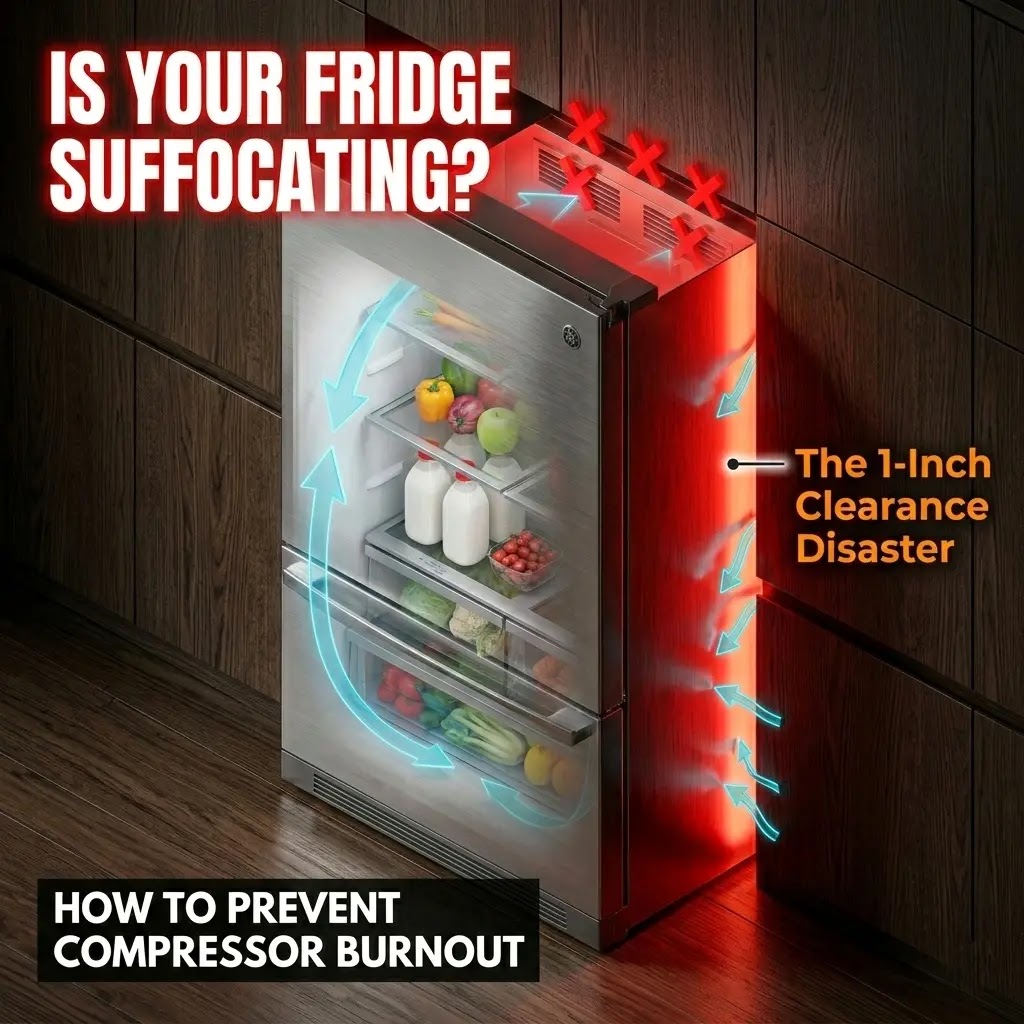
In peak summer months or poorly ventilated kitchens, the ‘tight-fit’ problem becomes a crisis. If your kitchen ambient temperature exceeds 32°C (90°F), your counter-depth fridge will hum 40% louder as it struggles to exchange heat in that narrow 2-inch gap.
The Noise Connection: As the fridge loses efficiency, the condenser fan is commanded by the computer to spin at maximum speed to save the motor. This creates a loud, high-pitched hum (often around 2,350 Hz). Furthermore, dirty coils can spike your monthly electricity bill by as much as 35%, essentially wasting $50 or more per month just to fight dust.
5. Placement Engineering: Reflection & Resonance

The material of your kitchen walls and floor significantly changes how you perceive fridge noise. This is called “acoustic transfer.”
- Drywall vs. Concrete: A concrete back wall is a reflective sound barrier. It reflects 80% to 90% of sound waves back into the room. If your fridge is backed against concrete, the hum will seem twice as loud as one backed against drywall, which absorbs some of the sound energy through vibration.
- Cabinet Resonance: Because counter-depth fridges fit tightly, the motor’s natural vibrations can transfer into the wood of the cabinets. The wood acts like the body of a guitar, amplifying the sound. This is Resonance, and it can turn a quiet motor into a loud cabinet rattle.
- Floor Type: Tile and hardwood floors are hard surfaces that reflect sound and transmit vibration easily. Tile is particularly problematic because it can vibrate against the fridge’s leveling legs if they aren’t perfectly adjusted.
6. Benchmark Decibel (dB) Levels: What is Normal?
To know if your fridge is truly loud, you can use a free decibel meter app on your phone to check against these 2026 benchmarks:
| Fridge Type | Standard dB Range | Perceived Sound |
|---|---|---|
| Luxury (Sub-Zero/Miele) | 32 dB – 37 dB | A soft whisper, library quiet. |
| Modern Inverter (Samsung/LG) | 38 dB – 43 dB | Quiet conversation; rustling leaves. |
| Dirty/Overheating Unit | 48 dB – 55 dB+ | There’s a noticeable hum from the next room. |
Thermal Expansion Popping: Aside from humming, you may hear loud cracking or popping sounds. This is normal thermal expansion. As the fridge cools down or goes through a defrost cycle, the internal plastic panels and metal coils expand and contract rapidly, creating sounds like someone breaking a stick. These are more audible in counter-depth models because the panels are closer to the exterior shell.
7. The Ice Maker Noise Paradox
In counter-depth models, the ice maker is often moved into the door or the top-left corner to save depth. This puts the water inlet valve very close to the user. Often, the motor humming people report is actually the inlet valve struggling.
The Buzzing Valve: If your water line is kinked or your house water pressure is too high (above 60 PSI), the solenoid valve will emit a loud, vibrating buzz every hour when the ice maker tries to fill. If you hear a loud buzz for 5–7 seconds every 15 minutes but no ice is being made, your water supply is likely turned off, and the valve is dry-firing, which can eventually burn it out.
8. Anti-Vibration Fixes (The Engineering Solution)

When leveling your fridge, don’t aim for a perfect flat line. Adjust the front legs so the unit has a slight backward tilt (about 0.25 to 0.5 inches higher in the front). This uses gravity to seal the doors tightly, reducing the amount of time the noisy compressor has to run.
If your fridge is healthy but resonant, you need to decouple it from your home’s structure. These solutions provide a 20% to 40% perceived noise reduction:
- Rubber Cork Pads: Placing a 1-inch thick rubber-and-cork pad under each leveling leg can stop vibration from traveling through hardwood or tile floors.
- Silicone Coasters: For a sleeker look, heavy-duty silicone coasters can absorb the kinetic energy of the motor.
- The Air-Gap Hack: Moving the fridge forward by just 0.5 inches (1.3 cm) breaks the resonance bridge between the unit and the cabinet wood and allows hot air to escape via the chimney effect.
9. The Red Line: When to Stop
Crossing this line can lead to legal fines or terminal damage to the appliance.
- EPA Section 608: It is a federal violation in the U.S. to handle or vent refrigerant gas without a license. Fines for individuals can reach $44,539 per day. Never attempt to top off the cooling gas yourself.
- No Knives: If you see frost, never use a knife to chip it away. Puncturing an aluminum evaporator coil will release the gas instantly and render the fridge unrepairable.
10. 2026 Tech: Smart Sensors and Self-Diagnosis
Apps like GE SmartHQ and LG ThinQ now feature Acoustic Fingerprinting. By holding your phone’s microphone near the motor, the app analyzes the sound frequency. It can distinguish between a dusty coil alert (high-frequency fan whir) and a compressor mounting failure (low-frequency thump) before you ever call a tech.
Expert FAQs
Q: Is it normal for my fridge to run 24 hours a day?
A: Yes, for modern inverter models. They are designed to run continuously at low power to save energy. It only becomes a problem if the sound becomes loud or if the fridge stops cooling.
Q: Why did my fridge get louder after I installed new tile flooring?
A: Tile is a hard surface that reflects sound and does not absorb vibration. Use rubber anti-vibration pads to decouple the fridge from the floor and reduce the reflected noise.
Q: Can I use soundproof foam on the fridge vents?
A: Absolutely not. You can put foam on the wall behind the fridge, but covering the vents on the machine itself will cause it to overheat and fail within months.
Q: How much space does my counter-depth fridge really need?
A: Most manufacturers require 1 inch on the sides and 2 to 3 inches at the back. Without this, the compressor temperature can rise to 160°F, cutting the unit’s life by 30%.
Conclusion: Summary of Proper Care
The tight-fit overheating solution is about allowing your high-performance fridge to breathe. Counter-depth fridges are unique machines that trade air space for aesthetics. By spending 10 minutes every month to vacuum your coils, check for cabinet resonance, and ensure a small air gap, you can maintain a silent kitchen and protect your $4,800 investment. Remember, modern inverter humming is the sound of efficiency, but a loud struggle is a cry for space.
🔍 Counter-Depth Expert Resource Center
Humming and overheating are often symptoms of deeper fitment or maintenance issues. Explore our 2026 field audits to master your slim-profile appliance:
- → The $500 Sleek Tax: Is Counter-Depth Actually Worth It? Uncover the truth behind the pricing and engineering challenges of 2026’s most popular kitchen trend.
- → Fit Issues Fixed: Step-by-Step Cabinet Clearance Solutions If your fridge is suffocating in a tight nook, use these hacks to restore airflow and stop the noise.
- → The 70% Rule: Why Your Slim Fridge is Failing (Fix It Now!) How internal organization prevents your inverter compressor from running at high-frequency RPMs.
- → How to Reset Your Counter-Depth Fridge After a Power Failure Clear cooling errors and recalibrate your VSC motor with these brand-specific button sequences.
- → Counter-Depth Refrigerators: Where Style Meets Practicality A positive look at the luxury models that successfully balance aesthetics with long-term reliability.