
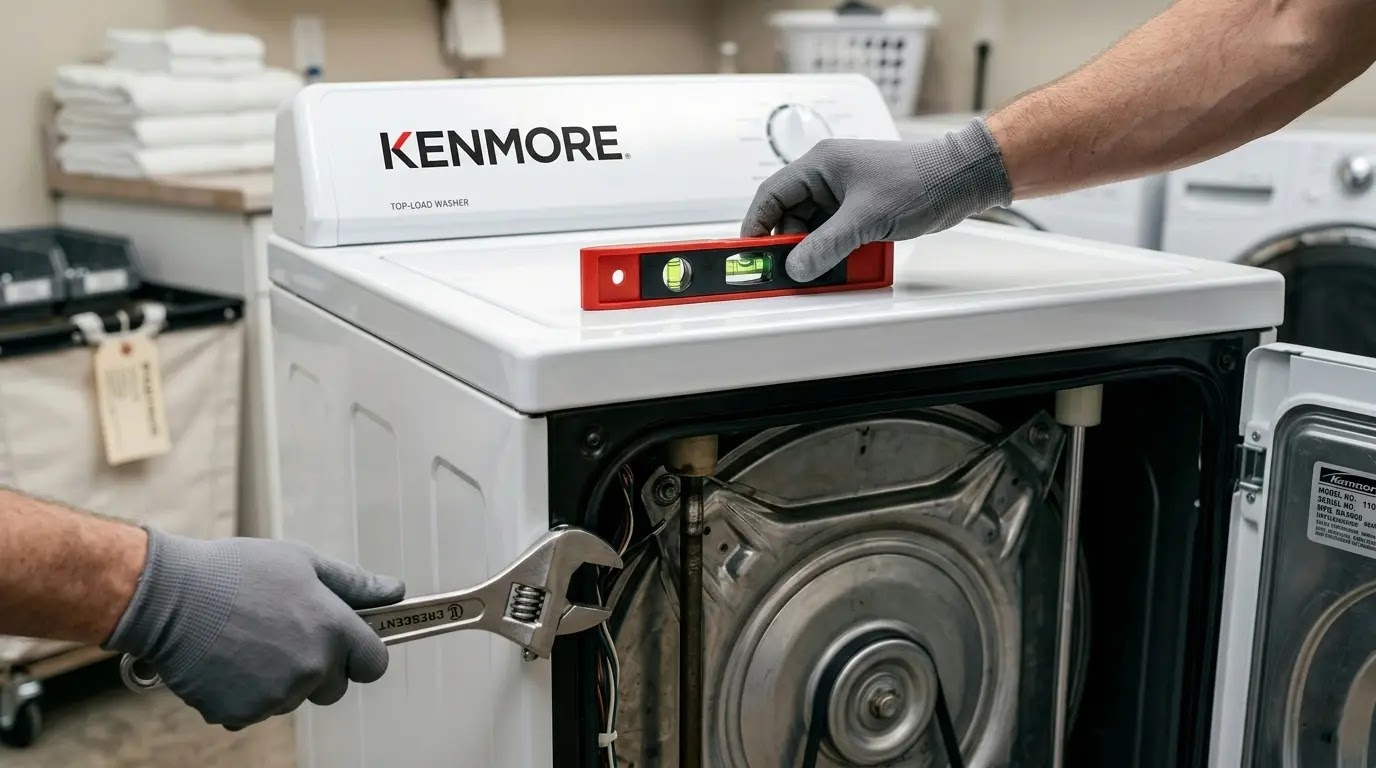
The 5-Minute Kenmore Washer Maintenance Hack: Save $250 on Repairs

Stop your washer from dancing and extend its life by 20 years with these simple DIY steps.
Technician’s Observation: In 2026, I often see homeowners treating their Kenmore washers like trash bins, loading heavy towels and king-size comforters all at once. Then they wonder why the machine is walking across the laundry room. A professional service call today starts at $250. However, if you take 5 minutes to learn this hack, your machine can easily last 20 years without a mechanic.
1. Curing the Walking Washer: Understanding Suspension
When your Kenmore top-load washer (especially the Prefix 110) bangs against the cabinet during the spin cycle, it’s not possessed, it’s exhausted. The drum is held in place by four Suspension Rods. These act exactly like the Shock Absorbers in your car, absorbing the energy from spinning wet clothes.
The Wear & Tear: Every spring has a weight limit. If you consistently wash heavy, wet towels, the tension in these springs weakens over time. If even one of the four rods loses just 15% of its strength, the drum will tilt, causing the machine to jump violently. Instead of buying a whole new tub, you likely just need a W10780045 Suspension Kit.
Professional Hack: When replacing these rods, use a long screwdriver as a lever. This prevents the 50-pound weight of the tub from crushing your fingers while you hook the new springs into place.

2. The UE Error: Your Machine is Afraid
If you own an LG-built Prefix 796 model, you’ve likely seen the UE code. This stands for Unbalanced Error. In 2026, washing machine computers have become highly sensitive. When the brain detects that the drum is leaning too far to one side, it triggers the UE code and stops the cycle to prevent the main bearings from shattering.
At 1,000 RPM, a single pair of heavy denim jeans can generate enough force to snap steel bolts if the load isn’t centered. Before you call a mechanic for a broken board, check if your load is tangled. Often, a UE code isn’t a mechanical failure; it’s the machine’s way of protecting itself from self-destruction.
3. Leveling Legs: The 2-Minute Balance Fix
Believe it or not, 50% of jumping machines are simply sitting on an uneven floor. If the washer is tilted even a quarter of an inch, all the water and heavy clothes will settle in the lowest corner, creating a massive imbalance.
The Hack: You don’t need a professional spirit level. Download a Bubble Level app on your smartphone. Place your phone on the top corners of the machine. If the bubble isn’t perfectly centered, rotate the adjustable legs at the bottom of the washer. This simple 2-minute adjustment can save the rear bearings of your Kenmore 100/500 Series from total collapse.
4. Shipping Bolts: The Rookie Mistake
This is a frequent issue in new homes or for people who have just moved. When a Front-Load (796 Series) Kenmore is shipped, the factory installs 4 large bolts in the back to lock the drum in place so it doesn’t move during transport.
If you run the machine without removing these, the washer will literally try to leap off the floor. Even in 2026, I see many professional installers forget to pull these out. Always check the back of your unit; there should be 4 large plastic-headed bolts. Removing them allows the drum to float on the suspension system as intended. For more details on these setup errors, check our Kenmore Buying Guide 2026.
5. The Drain Pump Treasure Chest: Testing the 85-Watt Motor

Does your Kenmore make a loud grinding or growling noise when it tries to drain water? Or are you seeing the OE Error (LG-built 796) or flashing drain lights? In 90% of cases, the pump isn’t broken; it’s just holding a treasure chest of lost items like coins, hairpins, or small toys.
The Technical Reality: The standard Kenmore 85-watt drain motor is engineered to move water, not metal. When a stray coin gets jammed in the Impeller (the small internal fan), the motor seizes. The control board waits for a Water Empty signal, and when it doesn’t receive it, the entire machine locks up to prevent a flood.
The 90-Day Maintenance Hack
If you have a Front-Load (796), there is a small trap door at the bottom front. Open it and unscrew the filter to clear the debris. If you have a Top-Load (110), you’ll need to tilt the machine back to access the pump from underneath. I once pulled out $3.50 in change and a rusted bobby pin from a pump that a homeowner thought was dead. Doing this every 90 days is even more important than a Kenmore Washer Reset.
6. The Smelly Washer: Killing the Biofilm Slime

If your laundry room smells like a swamp or an old drain, your machine has developed Biofilm. This isn’t just dirt; it’s a living army of bacteria that feeds on liquid fabric softeners and cold-water residues. In 2026, most people use Cold Wash cycles to save energy, but cold water actually helps these bacteria survive and grow.
The Thermal-Chemical Strike: To kill this slime, you need heat. Bacteria thrive in cold, but they die at temperatures above 60°C (140°F). Many people try to mix Vinegar and Baking Soda together, don’t do this! Chemically, they neutralize each other, leaving you with useless bubbles and water.
Pro Maintenance Tip: First, run a dedicated Hot Cycle with Vinegar to dissolve mineral deposits. Then, run a second cycle with Bleach or an Affresh Tablet to kill the bacteria. For a deep dive into this process, check our Kenmore Mold Cleaning Guide.
7. The 650-Gallon Threat: Hoses Matter
The standard black rubber hoses behind your machine are a ticking time bomb. After 5 years, the rubber becomes brittle. In 2026, modern home water pressures are higher than ever. If a rubber hose bursts during a high-speed spin cycle, it can dump 650 gallons of water per hour directly onto your floors.
Always upgrade to Braided Stainless Steel Hoses. These feature an EPDM core that handles extreme vibrations and pressure spikes without cracking. A $30 investment today can save you $10,000 in flooring repairs. This is the kind of durability we always look for, similar to what we noted in our Maytag vs. Kenmore Comparison.
8. Expert Field Notes: Consumer Q&A
Q: Why is my machine stuck on Sensing for 10 minutes?
A: Your Shift Actuator (the gear changer) is likely jammed. The control board is waiting for a 5VDC signal to confirm the lid is locked and the gears are engaged. This is a common $40 part and very easy to replace yourself.
Q: Should I leave my front-load door open after a wash?
A: 100% Yes! If you close the door, the 90% internal humidity will trigger mold growth within 48 hours. Always leave the door ajar (slightly open) to allow the drum to dry completely.
Q: My machine vibrates even when empty. Why?
A: Check your Shipping Bolts immediately. If the machine is new or has been recently moved, four large bolts in the back are locking the drum. If they aren’t removed, the machine will act possessed and jump violently.