
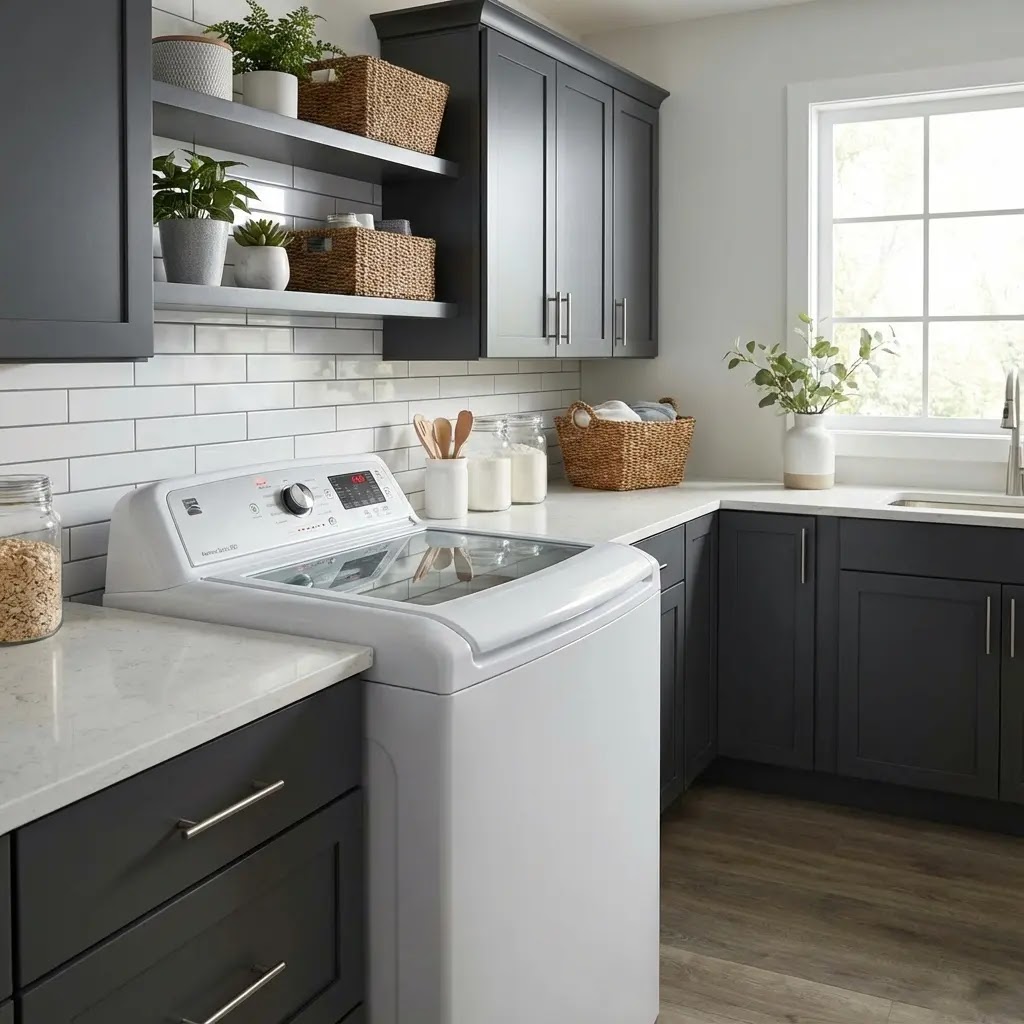
Kenmore Series 100/500 Washer Won’t Spin? Here is How to Fix It Without Losing Your Mind

Is your Kenmore Series 100 or 500 washer stuck with a blinking lid lock light? Don’t panic. Before you spend $300 on a technician, you might just need a manual reset. This guide covers the famous ‘Secret Knob Dance’ to recalibrate your machine and the $0 cleaning tricks to get it spinning again.
How Your Washer Thinks (And Why It Stops)
Note: These Kenmore models are built on the Whirlpool Vertical Modular Washer (VMW) platform. If you see similar issues on a Whirlpool, Maytag, or Amana, these exact steps will work for those brands too.
To fix the problem, you first need to understand why the washer is refusing to spin. Your Kenmore Series 100 or 500 is what repair people call a Vertical Modular Washer (VMW). Because these washers spin at extremely high speeds, they use a heavy-duty safety system to protect the user.
Inside the machine is a computer brain (the control board). When the cycle starts, the brain sends an electric signal to a locking magnet (the solenoid) inside the lid lock assembly. This magnet pushes a small bolt into a plastic hook on the lid called the strike plate. Once that bolt is locked in, a tiny internal switch sends a signal back to the brain saying, The door is locked; it is safe to spin.
If that bolt does not go in all the way, maybe because of dried soap gunk or because the machine is leaning to one side, the brain gets scared. It will not let the motor turn because it thinks the lid might still be open. Instead, it just clicks over and over and flashes that Lid Lock light to tell you it is stuck.
| Part | What it Really Does | What it Sounds Like When it Fails |
|---|---|---|
| Locking Magnet | Pushes the bolt into the lid | A clicking sound, but no spin |
| Internal Switch | Tells the brain we are safe. | The Lid Lock light flashes repeatedly |
| Strike Plate | The hole the bolt goes into | Clicking as the bolt misses the hole |
| Computer Brain | Runs the whole show | The washer won’t respond to buttons |
The Secret Knob Dance: How to Reset the Brain

Sometimes, there is nothing physically broken at all. Your washer might just have a bad memory from a power flicker or a lid that was opened at the wrong time. You can clear this memory with a secret sequence of knob turns.
If your machine behaves differently during the reset, you can check the [official Kenmore washer support and troubleshooting guides] for model-specific variations.”
Entering Maintenance Mode
First, make sure the washer is plugged in, but all the lights are off. (If they are on, hold the Start button for 3 seconds to cancel). Make sure the washer is empty and the lid is closed. Now, complete this sequence exactly within 6 seconds:
- Reset Position: Turn the knob one full circle to the left (counter-clockwise) and stop at the top (12 o’clock).
- Step 1: Turn the knob 3 clicks to the right (clockwise).
- Step 2: Turn the knob 1 click to the left (counter-clockwise).
- Step 3: Turn the knob 1 click to the right (clockwise).
If you timed it right, all the green status lights (Wash, Rinse, Spin, Done) will start blinking together. This means you are now talking to the machine’s brain. If they do not blink, turn the knob a full turn to the left to reset and try again, but move your hand a little faster.
The Brain Refresh (Calibration Cycle)
Once those lights are blinking, you should run a calibration cycle. This is a mandatory step anytime you replace a part or want the machine to relearn how to stay balanced.
- While the lights are blinking, turn the knob to the right until ONLY the Rinse light is on.
- Press the Start button.
- Now, walk away! For the next 2 to 3 minutes, the washer will click, whir, and spin the drum a little. Do not touch it! When it finishes, the lid will unlock, and all the lights will go off. Often, this simple reboot is all the machine needs to start working again.
Decoding the Light Patterns: Reading the Truth

If the reset did not work, the machine is trying to tell you exactly what is wrong using its status lights. Since most Kenmore 100/500 models do not have a digital screen, they use the lights as a secret code.
While in Maintenance Mode (lights blinking), turn the knob one click to the right and press Start. Then, turn the knob one click right again to see the code. The lights have point values:
- Wash = 4 points
- Rinse = 2 points
- Spin = 1 point
The machine will flash two patterns. The first flash is the F code (Fault), and the second is the E code (Error).
- F5 E1: Lid switch fault. The brain thinks the lid is open even if it is closed.
- F5 E2: Lid lock fault. The bolt is stuck or blocked by dirt.
- F5 E3: Unlock fault. The lock is stuck in the locked position.
- F7 E1 or E5: This means you have a shift actuator problem.
The Hidden Culprit: The Shift Actuator
If you hear a rapid clicking coming from the bottom of the machine rather than the lid, it might not be the lid lock at all. Underneath the washer is a part called the shift actuator. This is a small motor that shifts the machine from Wash mode to Spin mode. When it fails, the machine gets stuck between gears and clicks loudly. If your error code starts with F7, you likely need an actuator (Part #W10006355) rather than a lid lock.
If your Kenmore clicks but never spins, the motor might be trying to engage but failing. You can check the [washing machine motor overheating signs] to see if your actuator has already caused thermal stress to the engine.
Before ordering a new lid lock, make sure to verify your model number (found under the lid) with the [Kenmore Series 100/500 genuine replacement parts] database.
The $0 Fix: Cleaning and Leveling

Before buying parts, try these two steps. They solve many lid lock issues for free.
1. Cleaning with Alcohol
Washers are messy. Over time, dried laundry soap and lint build up inside the lock hole. This creates a sticky gunk that makes it hard for the locking bolt to slide out.
- Unplug the machine from the wall.
- Use a Q-Tip and rubbing alcohol.
- Scrub the inside of the lid lock hole and the strike plate on the lid. Keep cleaning until the Q-Tip comes out clean.
- Most lid lock failures are caused by dried detergent buildup. Following [expert maintenance tips for washing machines] once a month will keep your sensors clean and prevent that annoying ‘click-click’ sound.
2. The Bubble Test (Leveling)
Your washer must be perfectly flat. If it is tilted, the heavy tub leans to one side, making the lid slightly crooked. This causes the bolt to hit the plastic frame instead of the hole.
The Fix: Put a bubble level on top of the washer. If the bubble is not in the center, tilt the machine back and turn the feet at the bottom like a screw until it is level.
Replacing the Lock: The Putty Knife Trick

If the part is dead, you will need part number W10404050. The hardest part is opening the top without breaking the plastic clips.
The Pro Tip: Use a thin putty knife. Slide it into the thin crack between the top of the machine and the control box, about 6 inches from the corners. Push the knife in to release the hidden metal clips, and the control panel will flip up easily.
Installation Steps:
- Unplug the washer and tape the lid shut so it does not fall.
- Unplug the wire bundle from the board.
- Unscrew the two screws holding the old lock to the underside of the top.
- Put the new lock in and snap the control box back down.
- Mandatory: Run the Calibration Cycle (Rinse light only) after installing the part, or the machine might not work.
Frequently Asked Questions (FAQs)
Q: Can I just bypass the lid lock with a wire?
CRITICAL WARNING: Bypassing the lid lock on a Kenmore VMW system can send a high-voltage feedback loop to the Main Control Board. This can fry the computer chip, turning a $30 repair into a $400 disaster. Always replace the part; never jump the wires.
Q: How much does a lid lock replacement cost?
Q: Why does my new lid lock still click and not work?
Professional Conclusion
A Kenmore Series 100 or 500 washer that refuses to spin is a common problem, but it is rarely the end of the machine’s life. By understanding how the safety system works, from the knob dance reset to the alignment of the strike plate, most homeowners can fix the issue in about 20 minutes.
The best way to handle this is to be patient: start with a software reset (calibration), try a quick cleaning, and only replace parts once the error codes have confirmed they are broken. This systematic process not only saves hundreds of dollars in service fees but also helps your washer last for many more years. With the right tools and a little bit of effort, you can move past the frustration and get back to your routine with confidence.