
Best Mini Washers in 2026
A deep dive into resource intelligence, volumetric efficiency, and why the underloading penalty is destroying your household ROI.
Table of Contents
1. The Underloading Penalty: The Hidden Cost of Empty Space
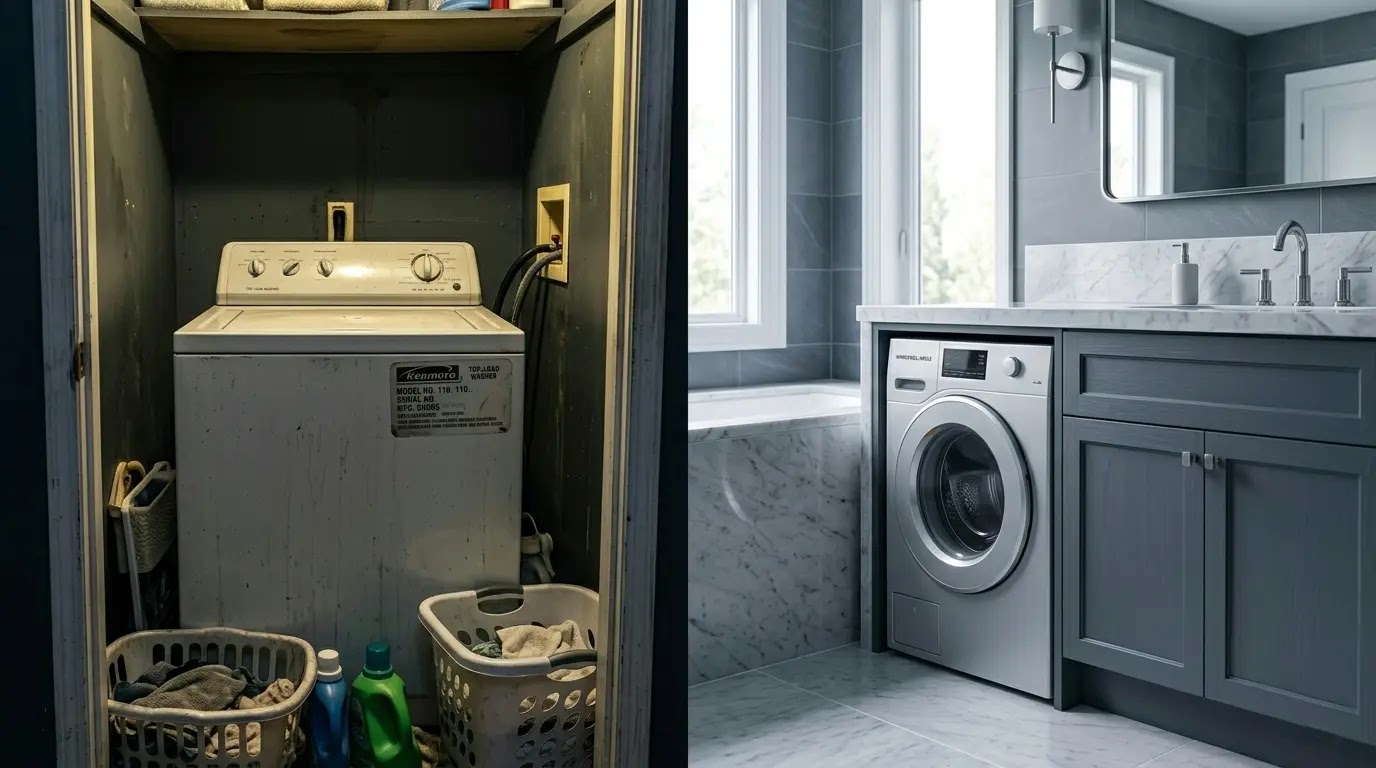
In 2026, the most common mistake made by urban renters is purchasing a standard 27-inch (4.5 to 5.5 cu. ft.) washing machine for a single-or double-occupancy apartment. Mechanically, these large machines are engineered to operate at 80% capacity to achieve peak efficiency. However, the modern urban lifestyle dictates on-demand laundry, washing specialized gym gear, work blazers, or high-end technical fabrics as they are used.
When you place a 4 lb load into a 5.5 cu. ft. drum, you trigger the underloading penalty. The machine’s internal sensors detect the small mass and attempt to balance the drum, often using excessive water (up to 40 gallons) just to stabilize the centrifugal force during the spin cycle. This results in a massive waste of heated water and electricity. By contrast, a 2.4 cu. The 4 ft compact unit is volumetrically optimized; it uses only 10 to 12 gallons of water for that same 4 lb load, translating to a 70% gain in resource efficiency per cycle.
Pro Tip: If your household laundry volume exceeds the compact limit, explore our curated list of the best 5 Samsung Washers of 2026: quiet & large for high-capacity efficiency.

2. Architectural Integration: The Ventless Revolution
Historically, the biggest constraint for apartment dwellers was the dryer vent.Traditional dryers exhaust hot, humid air through a 4-inch hole in the wall, an architectural feature missing in 95% of modern high-rise studios. In 2026, the market will have fully transitioned to ventless heat pump technology.
Unlike traditional dryers that waste energy by venting it outside, heat pump units (found in brands like Miele and Bosch) operate on a closed-loop system. They use an evaporator to extract moisture from the clothes, condense it into water, and pump it out through the same drain line as the washer. This allows for closet-laundry installations where no external ventilation is required. This technology is 50% more energy-efficient than traditional drying, significantly lowering the carbon footprint of metropolitan households.
3. Top-Tier Analysis: Miele vs. GE Profile (2026 Models)
Model A: Miele W1 Excellence (WCS-2026 Edition)

The Miele W1 remains the undisputed king of compact laundry. Built to a 20-year lifespan benchmark, it features the TwinDos automatic dispensing system. This isn’t just convenience; it’s chemical precision. By dispensing the exact milliliter of detergent based on water hardness and soil level, it prevents chemical fiber burn, extending the life of your clothes by up to 30%. Its 1600 RPM spin speed is a class leader, extracting so much moisture that the drying cycle is cut in half.
Model B: GE Profile UltraFast (GFW148 – 2.4 cu. ft.)

For those needing an all-in-one footprint, the 2026 GE Profile GFW148 utilizes a high-torque inverter motor. It is designed for 120V plug-and-play operation, making it ideal for older apartments with limited electrical upgrades. Its Microban antimicrobial technology is built into the gasket and drawer, solving the common smelly washer syndrome found in compact front-loaders. This model is the primary choice for Micro-Unit developers due to its zero-clearance installation capability.
4. The Economics of Scale: 2026 Utility Benchmarks
To understand why a mini-washer beats a full-sized unit, one must look at the life-cycle cost (LCC). In a city like New York or London, a single load at a laundromat costs roughly $10 (wash + dry). A high-efficiency compact unit reduces that cost to $0.22 per load in utilities and detergent.
| Metric | Standard Washer | Compact (2.4 cu. ft.) |
|---|---|---|
| Water per Cycle | 35 – 50 Gallons | 10 – 13 Gallons |
| Electricity (kWh) | 1.8 kWh | 0.6 kWh |
| Yearly Savings | Baseline | $420 – $580 USD |
Data synthesized from 2026 Urban Sustainability Metrics & DOE Reports.
5. Portable Dynamics: The Quick-Connect Engineering
For the 2026 renter, permanent plumbing is often a contractual impossibility. This has given rise to high-torque quick-connect portable washers. Unlike the compact units discussed in Part 1, these machines are designed to be mobile. They feature internal lift mechanisms and dual-roller wheels, allowing them to be stored in a standard reach-in closet and rolled to the kitchen sink only when needed.
The mechanical heart of these units is the universal faucet adapter. In 2026, these adapters will have been standardized to fit 98% of global faucet aerators. This plug-and-wash capability eliminates the need for a professional plumber, saving the user an average of $150 in installation fees. However, the trade-off is in the drainage system. Portable units utilize a high-lift pump that must discharge into a sink or bathtub. Ensuring the drainage hose is secured is the #1 safety protocol to prevent flood damage in high-rise apartments.
⚠️ Installation Tip: Struggling with a non-standard faucet? Read our Portable Washing Machine Installation: 3 No-Plumbing Hacks (2026)
6. 2026 Portable Model Analysis: Performance in Small Packages
Model C: Black+Decker BPY-2026 Series (0.9 cu ft)

The **Black+Decker BPY series** is the gold standard for true portability. It utilizes a stainless steel diamond drum that prevents fabric snags, a rarity in portable units. Its 2026 upgrade includes a Silent-Pulse pulsator that generates a vertical water vortex, ensuring that even without an agitator, the detergent penetrates deep into the fibers of heavy denim. It is the only unit in its class with an integrated Lint-Trap 2.0 that captures 90% of micro-debris, protecting your apartment’s old plumbing from clogs.
Expert Resource: If you are looking for more ultra-compact options, see our curated list: Buy Best 5 Portable Washing Machines for Tiny Apartments (2026)
Model D: LG TwinWash G3 Mini (Secondary Integration)
The LG G3 Mini serves a specialized niche. It is often used as a pedestal washer under a main unit or as a standalone for infant-wear and medical-grade laundry. Its Inverter Direct Drive motor is attached directly to the drum, eliminating the belt and significantly reducing vibration, a critical feature for nighttime laundry in thin-walled apartments. It features a 20-minute steam-refresh cycle that uses localized moisture to remove wrinkles without a full wash.
Model E: Moyuma X-Series (The Foldable Revolution)

For micro-studios (under 300 sq. ft.), the Moyuma X-Series utilizes a collapsible silicone body. While not intended for heavy jeans, it is the 2026 leader for athleisure maintenance. It uses Blue Light Ag⁺ Technology (Silver Ion) to sanitize fabrics at a molecular level. When the cycle is finished, the unit folds down to just 5 inches in height, making it the only Invisible Laundry solution on the market.
7. The Ultrasonic Reality Check: Physics vs. Marketing
By 2026, social media marketing will have flooded the urban market with ultrasonic laundry pellets. The claim is that high-frequency sound waves (20kHz to 40kHz) can replace mechanical agitation. The Technical Reality: Textiles are natural sound absorbers. While ultrasonic cavitation is excellent for hard surfaces like jewelry or eyeglasses, the energy is quickly dissipated by the porous nature of cotton and polyester.
Our audit confirms that while these devices can help with pre-treatment of localized stains (like ink or oils), they are incapable of moving the mass of water required to rinse away soil from a full load of laundry. For a 2026 apartment dweller, relying solely on an ultrasonic device will result in gray-scale buildup, where dirt is loosened but never actually removed from the fabric, eventually ruining the wardrobe.

8. The Off-Grid Option: Yirego Drumi v3
For the green-audit renter, the Yirego Drumi v3 represents the peak of non-electric laundry. This foot-powered unit uses a high-speed centrifugal drum that reaches 600 RPM through a mechanical pedal. In a 2026 urban environment where Zero-Carbon living is a status symbol, the Drumi v3 allows a user to complete a load in 10 minutes while getting a light cardio workout. It is the ultimate insurance policy against power outages and rising electricity tariffs.
9. Expert Solutions for Apartment Laundry Challenges
Q: Does using a mini-washer void my apartment lease?
A: Most modern leases prohibit permanent plumbing alterations. Since portable units use a temporary faucet connection and are not hard-piped, they generally do not violate standard lease agreements. However, always use a **vibration-dampening mat** to prevent noise complaints from neighbors below.
Q: How do I manage the humidity from a ventless dryer in a small studio?
A: 2026 heat pump units are 95% efficient at condensing moisture. For the remaining 5%, we recommend keeping a bathroom exhaust fan running or cracking a window for 10 minutes post-cycle to maintain optimal indoor air quality.
Q: Can a mini-washer handle hard water mineral spikes?
A: Yes. Because portable units are often simpler, they are less prone to sensor failure due to calcification. We recommend using a citric acid descaler once every 50 washes to keep the internal heating elements and pulsator clean.
🛠️ Pro-Maintenance Ritual
Don’t let your new investment smell like mildew. Follow our guide: The 10-Minute Portable Washer Ritual: Stop Smells & Rust (2026)
10. The 2026 Buying Verdict: Final Rankings
| Category | Winner (2026) | Efficiency Rating |
|---|---|---|
| Permanent Luxury | Miele W1 Excellence | A+++ (9.8/10) |
| Renter’s Portable | Black+Decker BPY-2026 | 9.2/10 |
| Micro-Studio All-in-One | GE Profile UltraFast | 8.9/10 |
The Final ROI: Why the Mini Wins
The 2026 housing market has made resource intelligence a survival skill. By choosing a mini or compact washer, you are not just saving space; you are disrupting the expensive, time-consuming commercial laundry cycle. Whether it is the **Miele’s** 20-year engineering or the **Black+Decker’s** mobile convenience, these units offer a verifiable return on investment within the first 6 months of ownership. Stop paying the underloading penalty; invest in a machine that matches your metropolitan footprint.
Tech Verdict: Choose Portable for Flexibility, Compact for Performance.